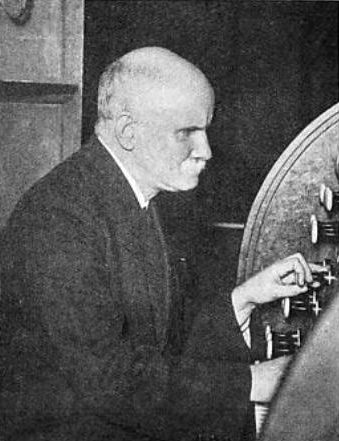
.png)
William Wolstenholme
1865 — 1931
William Wolstenholme was an English composer and organist. He was blind from birth.
Adapted from the Wikipedia article on William Wolstenholme.
From the period sources
William Wolstenholme, an eminent English organist, was born in Blackburn in 1865 and was blind, according to The New Encyclopedia of Music and Musicians (1924). A pupil of Done, he began playing in Blackburn in 1888, later serving at the Weigh House Chapel in London from 1902 to 1904, and subsequently at All Saints’ (Norfolk Square). He gained renown as a recitalist in England and abroad from 1885, making his American debut in 1908. His pedagogical influence extended to American students, as J. Frank Frysinger studied organ and composition with him in London from 1903, as recorded in Grove’s Dictionary of Music and Musicians: American Supplement (1920). Wolstenholme’s prolific output, as detailed by The New Encyclopedia of Music and Musicians (1924), includes approximately sixty organ works, such as two sonatas, a Grand Chœur on the 4th Gregorian tone, fantasias, preludes, and a Festival Toccata. Beyond organ music, he composed a suite for strings, a wind-quintet, two string-quartets, a piano-quartet, a piano-trio, a violin-sonata, a piano-sonata, numerous other pieces, the cantata Lord Ullin’s Daughter, and various part-songs and songs.