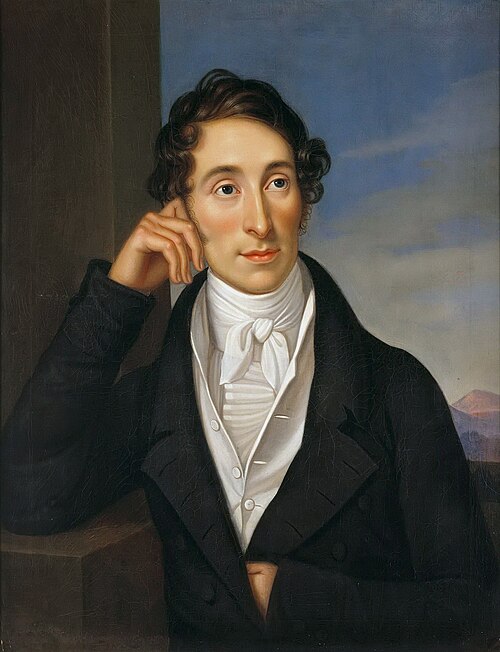

Carl Maria von Weber
1786 — 1826
Carl Maria Friedrich Ernst von Weber was a German composer, conductor, virtuoso pianist, guitarist, and critic in the late Classical and early Romantic eras. Best known for his operas, he was a crucial figure in the development of German Romantische Oper.
Adapted from the Wikipedia article on Carl Maria von Weber.
From the period sources
Weber’s opera Der Freischütz, with a libretto by Friedrich Kind, premiered in Berlin on June 18, 1821, after its score was completed in Dresden the previous year, according to Cyclopedia of Music and Musicians (1889). This work, initially titled “Der Probeschuss” and then “Die Jägerbraut,” was founded on a story from Johann August Apel and Friedrich Laun’s Gespensterbuch. Two years later, his grand romantic opera Euryanthe premiered at the Vienna Court Opera House on October 25, 1823, with Weber himself conducting. Despite a “storm of applause” at its debut, Euryanthe was performed only seven times in Vienna, though it later found success in Berlin, Weimar, and Dresden. Weber was an intimate friend of the famed clarinettist Heinrich Joseph Bärmann, for whom both Weber and Mendelssohn composed various clarinet pieces, as noted in A Biographical Dictionary of Musicians (1905). After Weber’s death, Karl Gottlieb Reissiger succeeded him as conductor of the German Opera at Dresden in 1827, and Reissiger is “generally supposed to have been the composer of the piece known as ‘Weber’s Last Waltz’,” according to Grove’s Dictionary of Music and Musicians (1922).