A guide to
Johann Gottfried Walther
Erfurt 1684 — Weimar 1748
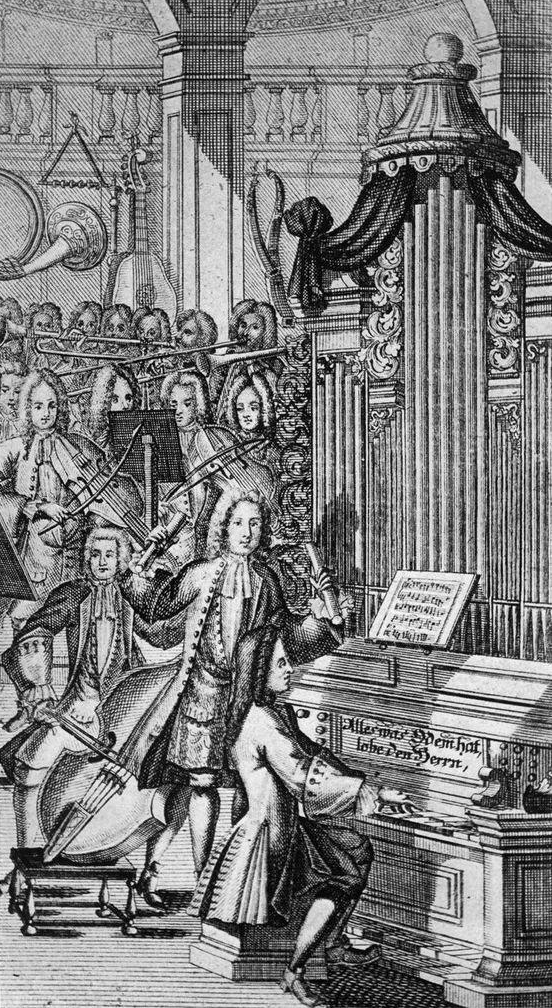
Johann Gottfried Walther is the most underappreciated organist of the German Baroque. He spent his entire adult life — forty-one years — at a single instrument, the Stadtkirche organ in Weimar; he wrote one of the most important chorale-prelude collections of the eighteenth century; he helped bring Italian concerto style into the German organ repertory through his concerto transcriptions; and he compiled, on his own time and at his own expense, a pioneering music dictionary, commonly described as the first comprehensive one printed in German. He was also Bach’s cousin and close personal friend. None of this saved him from spending his final decade in genuine financial distress.
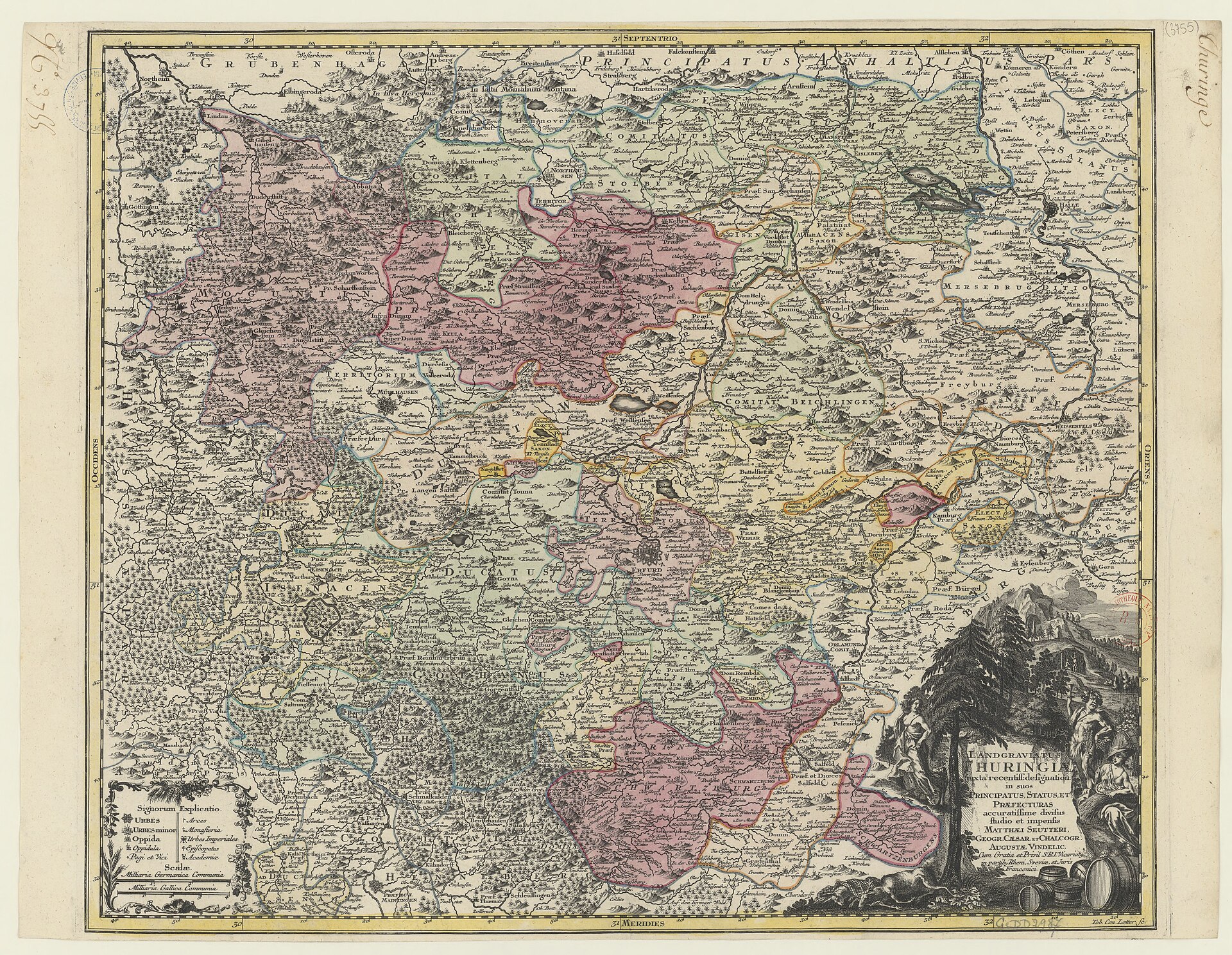
He was born in Erfurt on 18 September 1684 — six years before Bach himself. The Walthers and the Bachs were related on the maternal side: Walther’s mother, Martha Dorothea Lämmerhirt, was a cousin of Bach’s mother Elisabeth Lämmerhirt. The two boys would have known each other from family gatherings long before they were colleagues. Walther studied organ and composition with Johann Heinrich Buttstett (a pupil of Pachelbel), and at eighteen was already organist of the Thomaskirche in Erfurt.
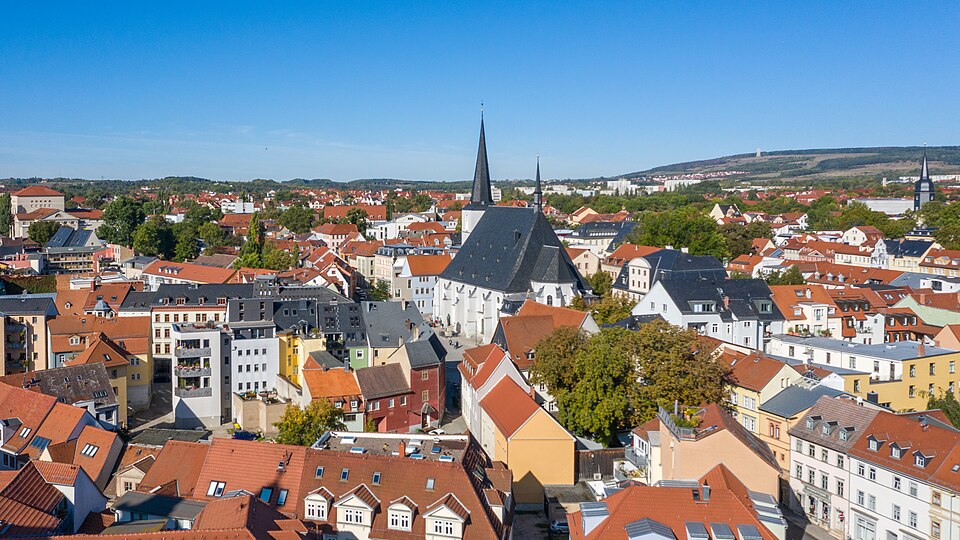
In 1707 he moved to Weimar as organist of the Stadtkirche St Peter und Paul (now known as the Herderkirche) — the great civic Lutheran church of the Saxon-Weimar capital. The following year, in July 1708, J. S. Bach arrived to take up the court-organist post at the Schlosskirche, a five-minute walk away across the Marstallhof. The two would be next-door colleagues for nine years, from Bach’s appointment in 1708 to Bach’s bitter departure for Köthen in 1717.
The Weimar years with Bach
The friendship between Walther and Bach during those nine Weimar years is among the most documented relationships in Bach scholarship. They exchanged compositions; they corresponded about the works of older composers; they stood as godfathers to each other’s children (Walther was godfather to Carl Philipp Emanuel Bach at the boy’s baptism in March 1714); they swapped publications and instrument plans. Walther’s surviving letters to the Leipzig publisher Heinrich Bokemeyer in the 1730s contain more anecdotal information about Bach than almost any other contemporary source — including the famous and otherwise-unrecorded story that Bach had been challenged to a keyboard contest in Dresden in 1717 by the visiting French virtuoso Louis Marchand, who is said to have fled town the morning of the contest rather than face him.
Walther also taught Wilhelm Friedemann Bach — the eldest Bach son — when the boy was very young, taking him on as a keyboard pupil in Weimar while his father was occupied with court business. The connection was close enough that decades later, when Friedemann had become organist at Halle, he kept up a correspondence with his old teacher.
The concerto transcriptions
In the years around 1713–14, Walther began a project that has been historically overshadowed by Bach’s related project from his Weimar years: he was systematically transcribing Italian concertos for solo organ. Vivaldi, Albinoni, Telemann, Torelli, Manzia, Gentili — Walther reduced their string-orchestra concertos to two manuals plus pedals, preserving the ritornello-and-episode dialogue of the originals on a single keyboard. Walther reported making 78 such transcriptions; only 14 are known to survive.
Walther and Bach both made concerto transcriptions during their Weimar years. The surviving evidence does not establish which composer began first or how directly they influenced one another. The technique — taking polyphonic instrumental music and making one player sound like five — became one of the central pedagogical exercises of the late Baroque; Walther’s surviving transcriptions form an important body of examples.
The Musicalisches Lexicon
In 1732 Walther published, with the Leipzig firm of Wolffgang Deer, his Musicalisches Lexicon, oder Musicalische Bibliothec — a pioneering German-language music dictionary and an early encyclopedic reference work. Its more than 3,000 alphabetical entries cover technical terms, instruments, musical forms, composers, theorists, performers, courts and publishers. The work took him over a decade of evening labour at his own expense; the printed subscription list at the front of the book includes Bach’s name.
Bach (Johann Sebastian) the highly famous Hochfürstl: Sächs: Weissenfels-Kapellmeister and Director Musices and Cantor at the Thomas-Schule in Leipzig, born at Eisenach 1685, brother of Joh. Christoph Bach …
— Walther’s article on Bach in the Musicalisches Lexicon, Leipzig 1732
That article — five long paragraphs in the original — is the most extensive published account of Bach to appear in his lifetime. It names every post, lists the major publications, and includes a detail nobody else recorded: that Bach had once owned a “very fine and rare” pedal harpsichord built by Hildebrand of Naumburg. Without Walther we would know far less than we do about his cousin.
The Lexicon was a critical success and a commercial failure. The subscription model recovered some of the printing costs but Walther was never paid for the time. He spent his last fifteen years lobbying — unsuccessfully — for a court appointment that would relieve him of the parish-organist post’s financial precariousness. Bach wrote testimonials on his behalf. Telemann sent a similar letter. The court did not respond.
The end at Weimar
Walther died in his organ-loft apartments at the Stadtkirche on 23 March 1748, age sixty-three, two years before Bach. The Weimar parish register records his death simply as that of “Johann Gottfried Walther, Organist.” The court paid for a modest funeral. His widow received the customary one year’s salary continuation, and then nothing.
The chorale settings — over three hundred surviving — are the patient, fluent counterpart to Bach’s more rhetorical Orgelbüchlein. Where Bach compresses, Walther unfolds; where Bach intensifies, Walther sustains. The variation sets on Allein Gott in der Höh sei Ehr, Lobe den Herren, and Jesu, meine Freude are the recital staples; the chorale fantasias on Komm, heiliger Geist and Wir glauben all an einen Gott are the longer set-pieces.
The Musicalisches Lexicon, two centuries later, was the explicit model for the Grove Dictionary of Music and Musicians when George Grove launched the first edition in 1879. Walther, who had spent the 1720s reading every musical treatise he could borrow and writing thousand-word biographical entries on long-dead Italian theorists, is the great-grandfather of every musical reference work since.