.jpg)
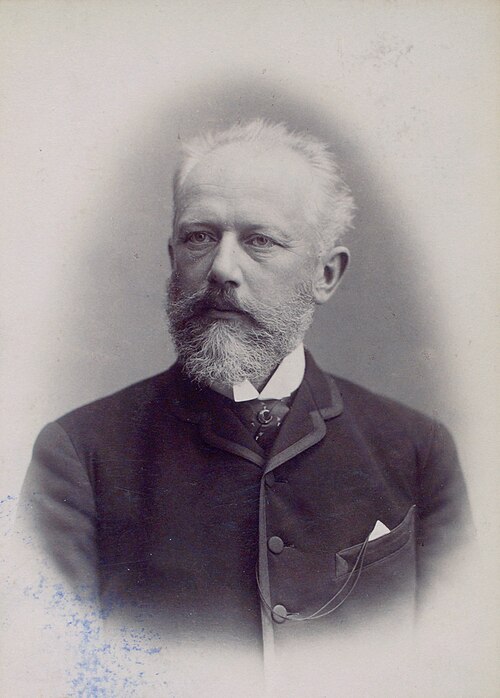
Pyotr Tchaikovsky
1840 — 1893
Pyotr Ilyich Tchaikovsky was a Russian composer of the Romantic period. He was the first Russian composer whose music made a lasting impression internationally. Tchaikovsky wrote some of the most popular concert and theatrical music in the classical repertoire, including the 1812 Overture, his First Piano Concerto, the Violin Concerto, the Romeo and Juliet Overture-Fantasy, several symphonies, the opera Eugene Onegin, and the ballets Swan Lake, The Sleeping Beauty and The Nutcracker.
Adapted from the Wikipedia article on Pyotr Ilyich Tchaikovsky.
From the period sources
Pyotr Tchaikovsky’s music was a specialty of Peter Jürgenson’s “great music-publishing house” in Moscow, founded in 1861, which added a printing establishment in 1867 (A Biographical Dictionary of Musicians, 1900). Tchaikovsky also played a role as a teacher, notably instructing the “remarkable pianist” Alexander Siloti from 1876 to 1881 (A Biographical Dictionary of Musicians, 1900). Another prominent figure, Sergei Rachmaninov, studied pianoforte with Tchaikovsky’s friend, Zvierev, and later with Siloti, and composed an “Elegiac trio (in memory of Tchaikovsky)” in 1893 (Grove’s Dictionary, 1922). Tchaikovsky’s influence extended to his contemporaries, offering a notable “tribute of admiration” to Rimsky-Korsakov in 1875, stating, “I am a mere artisan in music, but you will be an artist in the fullest sense of the word” (Grove’s Dictionary, 1922). His opera Eugene Oniegin saw its English production in 1892 at the Olympic Theatre, with Charles Manners singing Prince Gremin and Fanny Moody as the original English Tatiana (Grove’s Dictionary, 1904). Furthermore, his symphonic poem “Francesca da Rimini,” Op. 32, was first performed in 1876 and later earned him a Mus.D. degree when played in England in 1893 (Grove’s Dictionary, 1906). His “Pathetic” symphony is particularly noted for its second movement, which features a “genuine quintuple rhythm” (Grove’s Dictionary, 1904). Tchaikovsky is also recognized as one of the masters who exerted “exceptional influence” on the modern development of instrumentation and orchestration (The New Encyclopedia of Music and Musicians, 1924).