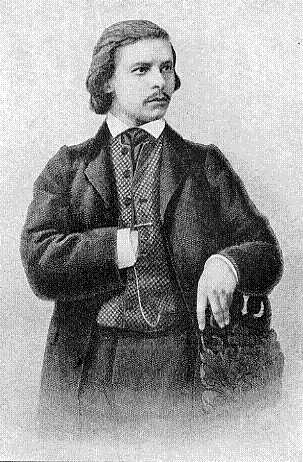

Carl Tausig
1841 — 1871
Karl Tausig was a Polish virtuoso pianist, arranger, and composer. He is widely regarded as Franz Liszt’s greatest pupil and one of the greatest pianists of all time. Today, he is mostly remembered for transcriptions for piano, in particular of works by J.S. Bach, as well as his piano exercises.
Adapted from the Wikipedia article on Karl Tausig.
From the period sources
Carl Tausig was a figure of considerable influence in the piano world, particularly noted for his teaching and his own virtuosic playing. Franz Liszt, a prominent teacher of the era, notably dubbed his pupil Eugene d’Albert “the young Tausig” on account of d’Albert’s “remarkable technique,” as recorded in A Biographical Dictionary of Musicians (1900). Tausig’s pedagogical approach was also foundational for other significant pianists; Moriz Rosenthal, for instance, became a pupil of Rafael Joseffy, who systematically grounded him on “Tausig’s method” in Vienna (Grove’s Dictionary of Music and Musicians, 1922). Oscar Beringer, another pianist, studied under Tausig in Berlin, later establishing an “Academy for the Higher Development of Pianoforte Playing” in London (Biographical Dictionary of Musicians, 1886). Tausig’s influence extended to American students abroad, with Amy Fay studying under him and Liszt, and Francis Joseph Campbell, an educator of the blind, also seeking instruction from Tausig in Berlin (Biographical Dictionary of Musicians, 1886). His technical prowess was such that he was considered among the “virtuosos who unite great technique with remarkable powers of interpretation,” alongside figures like von Bülow (Famous Composers and Their Works, 1891). Tausig also made his mark through his editorial work, arranging several of Domenico Scarlatti’s sonatas “to suit the requirements of modern pianists” (Grove’s Dictionary of Music and Musicians, 1906) and editing Clementi’s Gradus ad Parnassum with modern fingering (Cyclopedia of Music and Musicians, 1888). His arrangements of Strauss waltzes, Nouvelles Soirées de Vienne, were dedicated to Liszt and regarded as pendants to Liszt’s own Schubert arrangements (Cyclopedia of Music and Musicians, 1890).