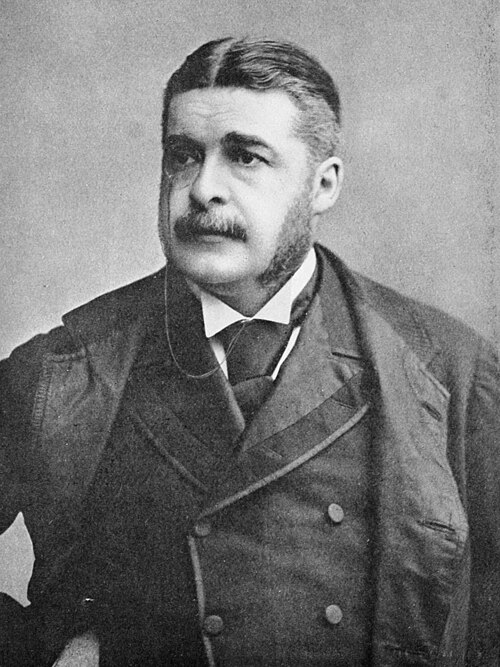

Arthur Sullivan
1842 — 1900
Sir Arthur Seymour Sullivan was an English composer. He is best known for 14 comic opera collaborations with the dramatist W. S. Gilbert, including H.M.S. Pinafore, The Pirates of Penzance and The Mikado. His works include 24 operas, 11 major orchestral works, ten choral works and oratorios, two ballets, incidental music to several plays, and numerous church pieces, songs, and piano and chamber pieces. His hymns and songs include “Onward, Christian Soldiers” and “The Lost Chord”.
Adapted from the Wikipedia article on Arthur Sullivan.
From the period sources
Arthur Sullivan, recognized as one of England’s notable artists in the 1880s (Biographie universelle des musiciens, 1880), was a significant figure in British music. His influence extended to teaching, with Eugene d’Albert studying harmony and composition under him at the National Training School in London in 1876 (A Biographical Dictionary of Musicians, 1900; Dictionary of Music, 1896). D’Albert, who would later be dubbed “the young Tausig” by Liszt, also studied with Sullivan at the Royal Academy of Music (Biographical Dictionary of Musicians, 1886; Cyclopedia of Music and Musicians, 1888).
Sullivan’s works were widely known and performed; for instance, George Benjamin Allen’s comedy-opera company produced several of his operas, including “The Sorcerer,” “H.M.S. Pinafore,” and “The Pirates of Penzance” (Biographical Dictionary of Musicians, 1886; A Biographical Dictionary of Musicians, 1900). London audiences were familiar with his operetta Cox and Box, particularly Sergeant Bouncer’s “Rataplan” part (Grove’s Dictionary, 1922). His cantata “On Shore and Sea” was written for and first performed at the opening of the Annual International Exhibition at Albert Hall in 1871 (Cyclopedia of Music and Musicians, 1888). Sullivan also composed incidental music to Shakespeare’s Henry VIII, published in 1879 (Cyclopedia of Music and Musicians, 1888). He was knighted by the Queen in 1883 and held honorary Mus. Doc. degrees from Cambridge (1876) and Oxford (1879), and was decorated with the “Légion d’Honneur” at the Paris International Exhibition of 1878 (Famous Composers and Their Works, 1891). Frederic Hymen Cowen succeeded him as conductor of the London Philharmonic in 1887 (A Biographical Dictionary of Musicians, 1900).