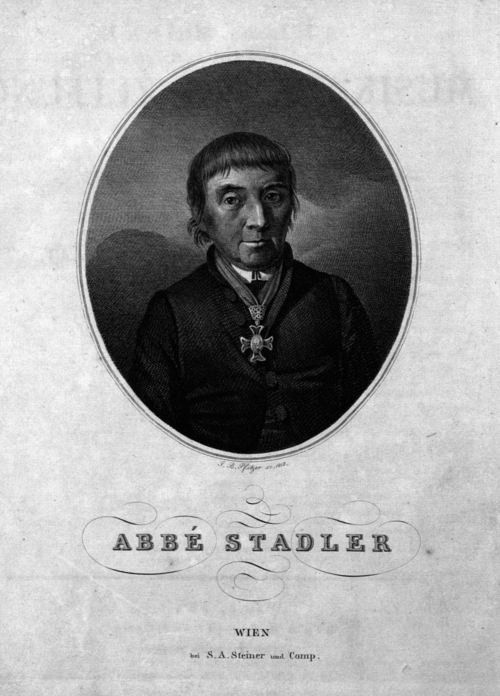

Maximilian Stadler
1748 — 1833
Maximilian Johann Karl Dominik Stadler, Abbé Stadler, born August 1748, in Melk – 8 November 1833, in Vienna), was an Austrian composer, musicologist and pianist.
Adapted from the Wikipedia article on Maximilian Stadler.
From the period sources
Maximilian Stadler appears in historical accounts primarily as a teacher and scholar, notably influencing several significant musicians. Franz Lachner, an eminent composer and contrapuntist, took “further lessons from Stadler, Sechter, and Weigl” in Vienna in 1822, according to A Biographical Dictionary of Musicians (1900). Similarly, Engelbert Aigner, a dramatic composer, is recorded as a “Pupil of Stadler” in A Biographical Dictionary of Musicians (1905), while Christoph Heinrich Girbert, a music professor, received his only formal instruction from “Cantor Stadler” in Baireuth, as noted in Cyclopedia of Music and Musicians (1889).
Beyond teaching, Stadler was involved in the musical circles of his time. He was an “intimate friend” of Franz Schubert, as stated in A Dictionary of Music (1908), and Schubert even composed a cantata for his friend Vogl’s birthday with words by Albert Stadler, as detailed in Grove’s Dictionary (1908). The “Abbé Stadler” also contributed to the ongoing debate surrounding Mozart’s Requiem, with Johann André publishing a new edition of the score in 1826, distinguishing Mozart’s parts from those by Süssmayer “on the authority of the Abbé Stadler,” according to Cyclopedia of Music and Musicians (1890). Stadler himself bequeathed the autograph of the Dies irae from the Requiem to the Imperial Library of Vienna in 1831. His name is also associated with the development of the clarinet, having contributed to the “extraordinary state of perfection” the instrument reached, as noted in Dictionary of Music (1896).