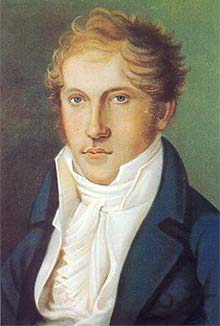

Louis Spohr
1784 — 1859
Louis Spohr, baptized Ludewig Spohr, later often in the modern German form of the name Ludwig, was a German composer, violinist and conductor.
Adapted from the Wikipedia article on Louis Spohr.
From the period sources
Louis Spohr was regarded by some contemporaries as a composer of “more than commonplace” music, with many individual pieces evincing “genius of a decidedly original turn,” particularly his piano works, which were considered “brilliant and effective” (Brown’s Biographical Dictionary, 1886). His compositions included a “Double Symph.” and “Historical Symph.,” popular enough to be arranged for piano, eight hands, by Orleana Andersen-Boker (A Biographical Dictionary of Musicians, 1900). Spohr was also a noted teacher, with several violinists studying under him in Cassel, including Karl Louis Bargheer (1848-50) and his brother Adolf Bargheer (1857-58), who was Spohr’s “last pupil” (Dictionary of Music, 1896). Other pupils included Jean-Nicolas-Conrad Goetze, sent by Grand Duchess Marie Paulowna to perfect his talent (Biographie universelle des musiciens, Vol. 4, 1883), and August Pott, who traveled to Cassel specifically to study with Spohr, whom he had chosen as his model (Biographie universelle des musiciens, Vol. 7, 1866). Spohr’s opera Faust was written in Vienna in 1813, though it premiered in Frankfort-on-the-Main in 1818, with a libretto bearing little resemblance to Goethe’s poem (Cyclopedia of Music and Musicians, Vol. 2, 1889). His oratorio Der Fall Babylons (The Fall of Babylon), composed in 1840, was performed at the Norwich Music Festival in 1842 and in London in 1843, with Spohr himself conducting (Cyclopedia of Music and Musicians, Vol. 2, 1889).