.jpg)
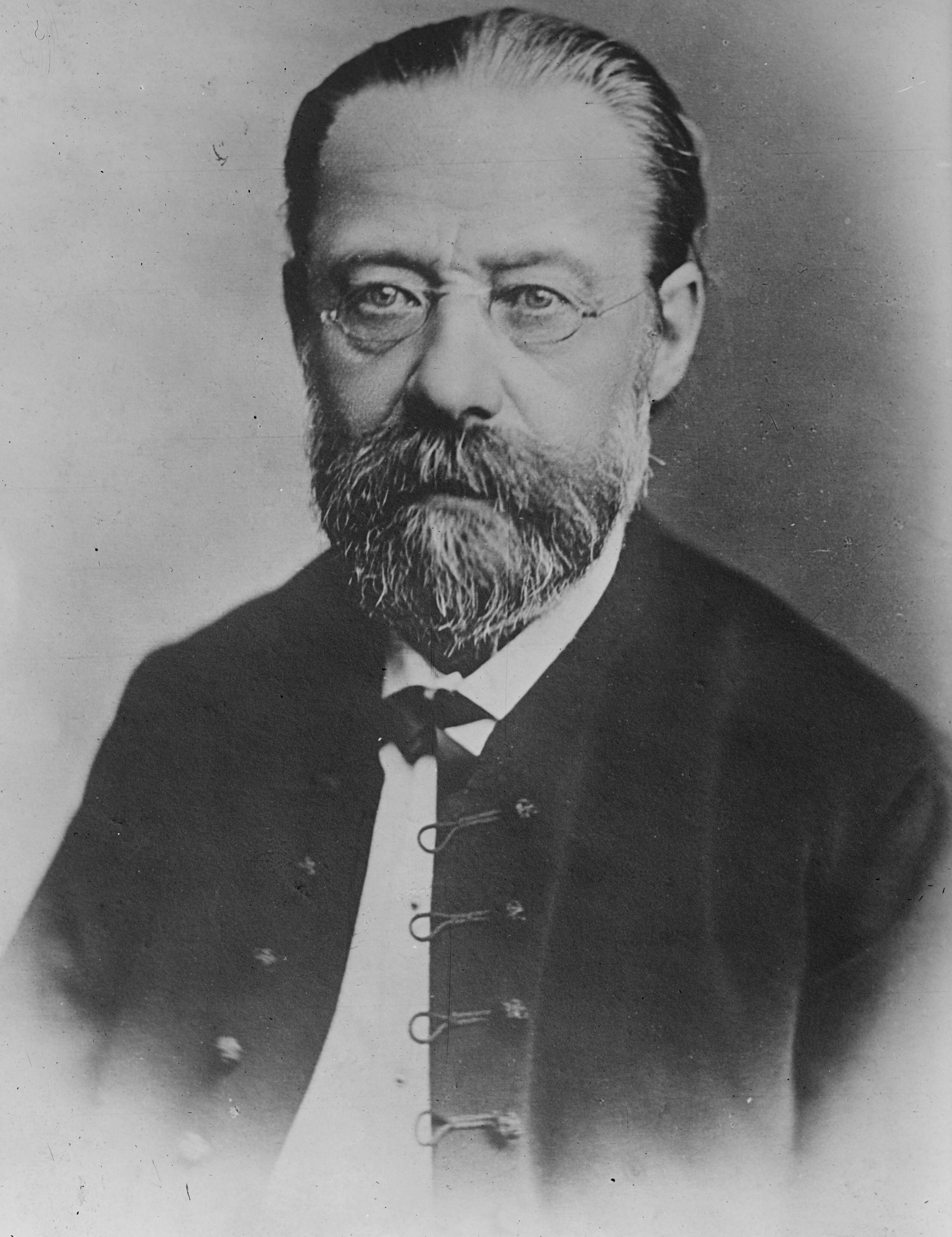
Bedřich Smetana
1824 — 1884
Bedřich Smetana was a Czech composer who pioneered the development of a musical style that became closely identified with his people’s aspirations to a cultural and political “revival”. He has been regarded in his homeland as the father of Czech music. Internationally he is best known for his 1866 opera The Bartered Bride and for the symphonic cycle Má vlast, which portrays the history, legends and landscape of the composer’s native Bohemia. It contains the famous symphonic poem “Vltava”, also popularly known by its German name “Die Moldau”.
Adapted from the Wikipedia article on Bedřich Smetana.
From the period sources
Bedřich Smetana, a highly skilled pianist, was a pupil of Proksch at Prague from 1843, and later studied for a short time with Liszt, according to Grove’s Dictionary (1908). One biographical dictionary from 1886 also records him studying “under R. Schumann, 1846.” Smetana opened his own music school in Prague, where he married the pianist Katharina Kolar, and counted Auguste Auspitz-Kolar, an “excellent pianist,” among his pupils (A Biographical Dictionary of Musicians, 1900).
Beyond his teaching, Smetana became a significant figure in Bohemian music, described by Grove’s Dictionary (1908) as “the first (and, as some think, the greatest) Bohemian composer who deliberately took his stand as an exponent of the art of his native country.” He was an “enthusiastic adherent of the Berlioz-Liszt-Wagner school,” as noted in The History of Music (1886), and is recognized, along with Karl Bendl and Dvořák, for “winning general recognition for Czech musical art” (A Biographical Dictionary of Musicians, 1900). His symphonic poems, such as Mein Vaterland, were seen to carry on the tradition of that form from Liszt, increasing its “power of pictorial expression” (Grove’s Dictionary, 1908). Smetana’s most famous work, The Bartered Bride (Prodana Nevesta), is considered “one of the most beautiful of modern comic operas” (Grove’s Dictionary, 1908), though its London performances had not achieved widespread public success by 1908. His career as chief conductor of the National Theatre in Prague, a post he held from 1866 to 1874, was cut short by increasing deafness, which he poignantly depicted in his String Quartet in E minor, “Aus meinem Leben,” with a “persistent high note in the finale… understood to be a deliberate statement concerning a note, similarly persistent to his own ear” (Grove’s Dictionary, 1908).