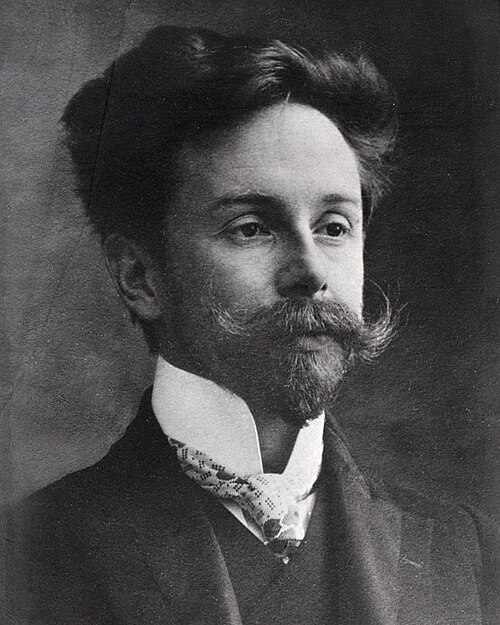

Aleksandr Scriabin
1872 — 1915
Alexander Nikolayevich Scriabin was a Russian composer and pianist. Initially influenced by Frédéric Chopin, he composed in a relatively tonal, late-Romantic idiom. Later, independently of his contemporary Arnold Schoenberg, Scriabin developed a highly dissonant musical language that transcended traditional tonality without being strictly atonal, aligning with his personal brand of metaphysics. He embraced the concepts of Gesamtkunstwerk and synesthesia, creating a colour-coded circle of fifths inspired by theosophy to associate colours with specific harmonic tones. Scriabin is widely considered the primary Russian symbolist composer and a major figure of the Russian Silver Age.
Adapted from the Wikipedia article on Alexander Scriabin.
From the period sources
Aleksandr Scriabin, a composer and pianist, initially pursued a military career in the Cadet Corps before dedicating himself to music, entering the Moscow Conservatorium. There, he studied piano under Safonov, earning a gold medal in 1892, as recorded by Grove’s Dictionary of Music and Musicians (1908, 1922). After completing his studies, Scriabin traveled abroad, establishing a considerable reputation as both a pianist and composer in cities such as Paris, Brussels, and Amsterdam. From 1898 to 1903, he served as a professor of pianoforte at the Moscow Conservatorium, subsequently devoting himself almost exclusively to composition.
Contemporary sources regarded Scriabin as “one of the most gifted of the younger Russian composers,” possessing a “distinctive style” and an attraction to “smaller musical forms,” much like Chopin, by whom he was “evidently been influenced” (Grove’s Dictionary, 1908, 1922). His pianoforte works were described as “delicate and poetical,” while in his larger compositions, he notably followed “the orchestration of Wagner rather than of Glinka with considerable effect.” Though his output was “not large,” it included two symphonies and a pianoforte concerto. His earlier teachers included George Edwardovitch Konius, according to Grove’s Dictionary of Music and Musicians: American Supplement (1920). Katherine Ruth Willoughby Heyman, an American pianist, was noted for giving the first American recital of Scriabin alone in 1919, featuring his 4th and 8th Sonatas (Grove’s American Supplement, 1920).