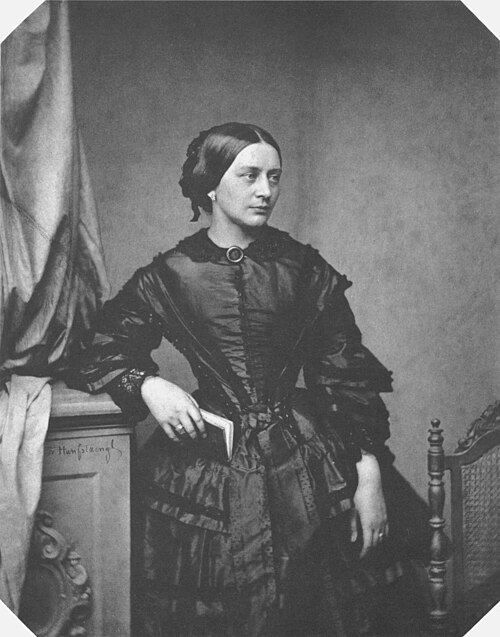
.jpg)
Clara Schumann
1819 — 1896
Clara Josephine Schumann was a German virtuoso pianist, composer, and piano teacher. Regarded as one of the most distinguished pianists of the Romantic era, she exerted her influence over the course of a 61-year concert career, changing the format and repertoire of the piano recital by lessening the importance of purely virtuosic works. She also composed solo piano pieces, a piano concerto, chamber music, choral pieces, and songs.
Adapted from the Wikipedia article on Clara Schumann.
From the period sources
Clara Schumann is noted in biographical works primarily through her familial and professional connections. According to Fétis’s Biographie universelle des musiciens (1880), she was the daughter of Frédéric Wieck, and her step-brother, Woldemar Bargiel, was the son of Auguste-Adolphe Bargiel, who married Wieck’s divorced wife. Bargiel’s compositions were described as “thoroughly inspired by Schumann” (Brown’s Biographical Dictionary, 1886), and he followed the tendencies of his “beau-frère Robert Schumann” (Fétis, 1880). As a celebrated pianist, Clara Schumann is mentioned in A Description and History of the Pianoforte (1896) as one of the eminent artists whose requirements the English action pianoforte, developed by Stodart and Broadwood, was found equal to. Her autograph was also featured in the Cyclopedia of Music and Musicians (1890).