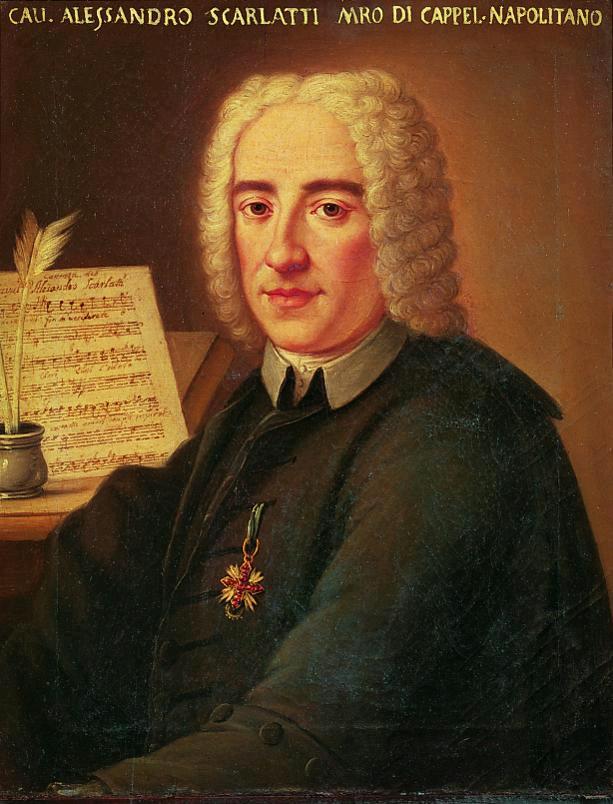

Alessandro Scarlatti
1660 — 1725
Pietro Alessandro Gaspare Scarlatti was an Italian Baroque composer, known especially for his operas and chamber cantatas. He is considered the most important representative of the Neapolitan School of opera.
Adapted from the Wikipedia article on Alessandro Scarlatti.
From the period sources
Alessandro Scarlatti, a Cavaliero from Naples, was a remarkably prolific composer, celebrated for having perfected the theatric style, according to A General History of the Science and Practice of Music (1875). This source records that he composed nearly a hundred operas, along with an “incredible number” of oratorios, serenatas, and cantatas, noting his invention was so fertile and his application so intense that his copyist could not write as fast as he composed. Among his vast output, only two works were known to be in print at the time of this 1875 account: Cantate à una e due Voci and Motetti à una, due, tre, e quattro Voci con Violini. He is also credited with first introducing violin accompaniments and symphonies into his airs, enriching the melody and providing relief for the singer.
His opera Pyrrhus and Demetrius was performed with “universal applause” in Rome, Naples, and other cities, and was considered “the finest in its kind of all Scarlatti’s works” (A General History, 1875). An English translation, with additional airs by Nicolini Haym, was staged at the Haymarket theatre in London in 1708, where, notably, Haym’s airs were distinguished by their “superior excellence.” Scarlatti’s influence extended to his pupils, who included prominent figures such as Emmanuele, Baron d’Astorga, and Nicola Porpora, a celebrated singing teacher and one of the “most savans musiciens” of the Neapolitan school, according to Biographie universelle des musiciens (1837, Vol. 7). Other students included Gaetano Greco, who succeeded Scarlatti as composition professor at the Conservatoire dei Poveri di Giesù Cristo and later taught Pergolesi and Vinci, and Domenico Gizzi, whom Scarlatti encouraged to open his own school for singers (Biographie universelle, 1883, Vol. 4). His son, Domenico, also became a renowned composer of harpsichord lessons, having served as chapel-master in Rome before entering the service of the King of Portugal in 1728 (A General History, 1875). Scarlatti’s operatic compositions are described as offering “beautiful flights of genius that survive all revolutions, and which one can admire in all times,” a quality that a contemporary, Caldara, was said to lack in his own dramatic music (Biographie universelle, 1883, Vol. 2).