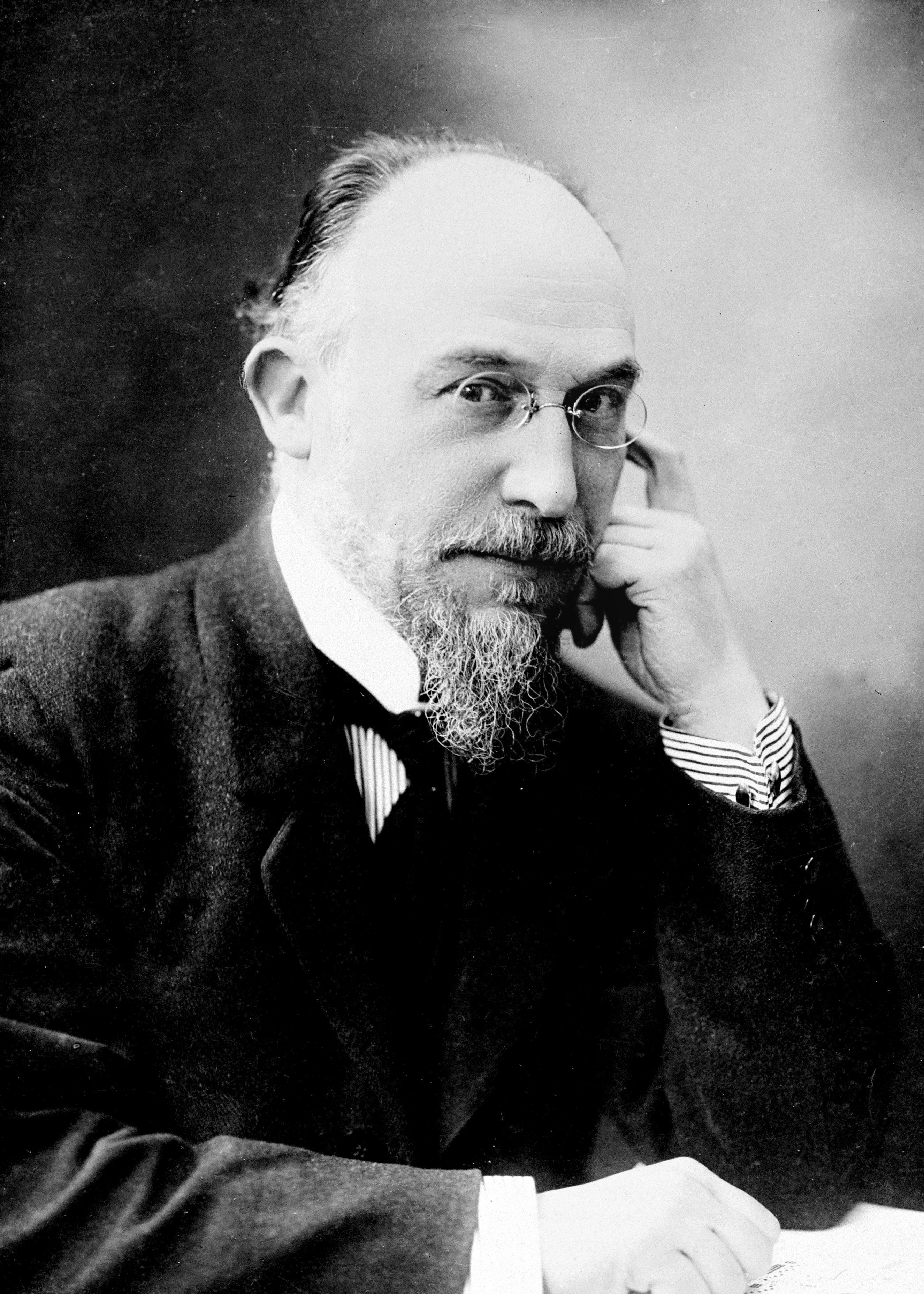

Erik Satie
1866 — 1925
Eric Alfred Leslie Satie, better known as Erik Satie, was a French composer and pianist. The son of a French father and a British mother, he studied at the Paris Conservatoire but was undistinguished and did not obtain a diploma. In the 1880s he worked as a pianist in café-cabarets in Montmartre, Paris, and began composing works, mostly for solo piano, such as his Gymnopédies and Gnossiennes. He also wrote music for a Rosicrucian sect to which he was briefly attached.
Adapted from the Wikipedia article on Erik Satie.
From the period sources
Erik Satie, a French composer, received his training spasmodically at the Paris Conservatory and the Schola Cantorum, in addition to studying with individual teachers, according to The New Encyclopedia of Music and Musicians (1924). As early as 1885, he had developed a style that resembled the later work of Debussy, and by 1889, the two composers had become intimate. From 1892, Satie was associated with a “mystic fraternity known as the Salon de la Rose-Croix.” His compositions include the comic opera Paul et Virginie, the symphonic drama Socrate (1918), the ballet Uspud (1892), and music for plays by Péladan, Mazel, Bois, and Feraudy, alongside a range of “more or less eccentric piano-pieces,” which began with his Ogives in 1886. Notably, Debussy orchestrated Satie’s Gymnopédies, nos. 1 and 3, for orchestra, as listed in Grove’s Dictionary of Music and Musicians: American Supplement (1920). Carl Van Vechten, a writer on musical subjects, was also “one of the first in America to write of… Satie,” championing the cause of modern music.