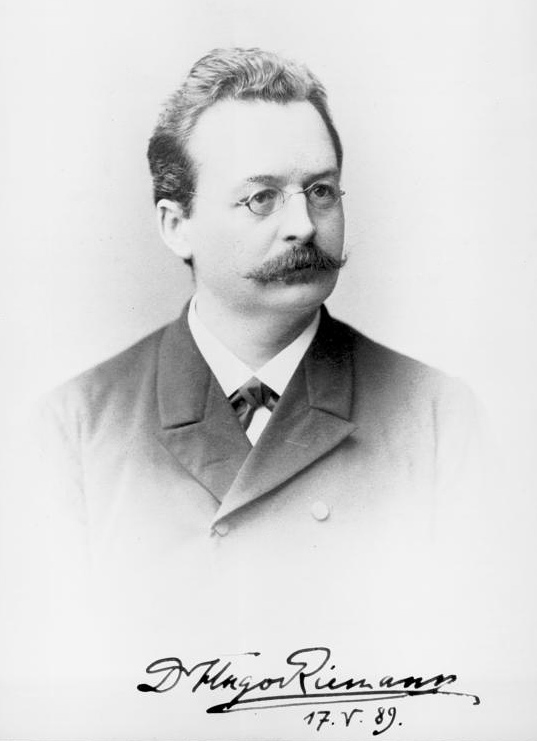

Hugo Riemann
1849 — 1919
Karl Wilhelm Julius Hugo Riemann was a German musicologist and composer who was among the founders of modern musicology. The leading European music scholar of his time, he was active and influential as both a music theorist and music historian. Many of his contributions are now termed as Riemannian theory, a variety of related ideas on many aspects of music theory.
Adapted from the Wikipedia article on Hugo Riemann.
From the period sources
Hugo Riemann is referenced in several early 20th-century musical dictionaries, often as an authority or source. For instance, A Biographical Dictionary of Musicians (1900) notes that Friedrich Wilhelm Agthe, a cantor at the Dresden Kreuzschule, was a pupil of Riemann in Dresden. Riemann is also cited in the same dictionary as an authority on historical dates, such as the period K. Ph. E. Bach served as chamber-musician to Frederick the Great, and as a source for information on Princess Marie A. Friederike of Saxony’s compositions.
Beyond biographical details, Riemann’s scholarly contributions are highlighted. A Biographical Dictionary of Musicians (1900) and its 1905 second edition mention him among those who reprinted Alypios’s “Introduction to Music,” a key source for understanding ancient Greek notation. His Musik-Lexikon (1887) is cited in Cyclopedia of Music and Musicians (1888) as the source for Michael Ivanovitch Glinka’s birth and death dates, which were otherwise disputed by leading biographers. Furthermore, Grove’s Dictionary of Music and Musicians (1908) lists Riemann’s Lexikon as a reference for composers like Guglielmo Quarenghi and Carl Reinecke, and for details on Johann Friedrich Fasch. Riemann’s own Dictionary of Music (1896, 1908) also includes his work “Wie hören wir Musik” (1888) and “Catechism of Musical Esthetics” in its discussion of “Absolute Music,” where he argues that music becomes symbolic when it attempts to awaken definite associations of ideas, thereby entering the domain of poetry or representative arts. His “Studien zur Geschichte der Notenschrift” is also referenced in the context of the historical development of accidentals.