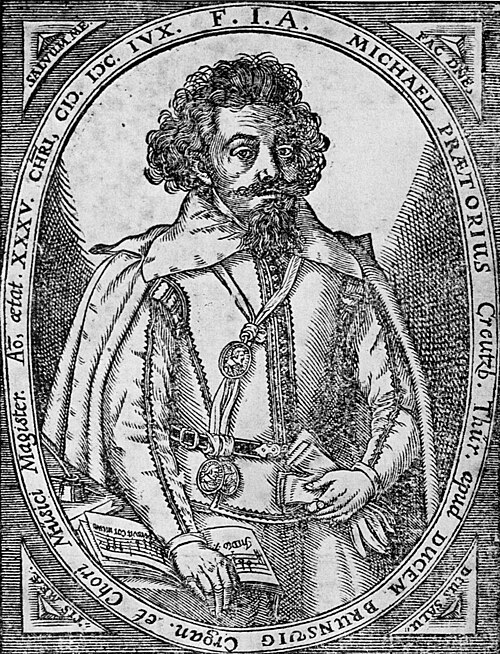

Michael Praetorius
1571 — 1621
Michael Praetorius was a German composer, organist, and music theorist. He was one of the most versatile composers of his age, being particularly significant in the development of musical forms based on Protestant hymns.
Adapted from the Wikipedia article on Michael Praetorius.
From the period sources
Michael Praetorius, whose surname was a Latinization of the German Schulz or Schulze, was a musician of high attainments both as a composer and writer, though few facts are known concerning his life (A Biographical Dictionary of Musicians, 1900). He served as Kapellmeister at Lüneburg, later becoming organist, and finally Kapellmeister and secretary to the Duke of Brunswick, also holding the post of Prior of the Monastery of Ringelheim, near Goslar (Cyclopedia of Music and Musicians, 1890). Praetorius is recognized as one of the most noted writers on music of his era, with his magnum opus, Syntagma Musicum, being a theoretical work of great value to students of musical history (Famous Composers and Their Works, 1891). This extensive work, printed in three volumes, includes an historical and descriptive treatise on ancient and ecclesiastical music, and ancient secular instruments (Vol. I, 1615), and a particularly important German-language volume describing musical instruments of the period, their form, compass, and tone-quality, with a detailed focus on the organ, and an appendix of 42 woodcuts (Vol. II, 1618).
Praetorius witnessed significant changes in music, endeavoring to educate his countrymen in the new Italian style of secular music, though he did not, like Heinrich Schütz, lose his nationality (Famous Composers and Their Works, 1891). His writings are cited in discussions of various musical practices and instruments; for instance, he is noted for his observations on the historical use of five-stringed viols (Grove’s Dictionary, 1922) and for recommending that composers write in necessary chromatic signs to avoid hesitation for singers (Grove’s Dictionary, 1904). He also described the “German Sackpfeife,” detailing four or five varieties of the bagpipe in his Syntagma Musicum (Grove’s Dictionary, 1904). His compositions were numerous, including the monumental Musae Sioniae, a collection of 1244 vocal numbers across nine parts, and Terpsichore, a collection of dance-pieces (A Biographical Dictionary of Musicians, 1900). Carl Riedel, a 19th-century conductor, notably published an edition of Praetorius’s “Weihnachtslieder,” demonstrating the enduring value of his work (A Biographical Dictionary of Musicians, 1900).