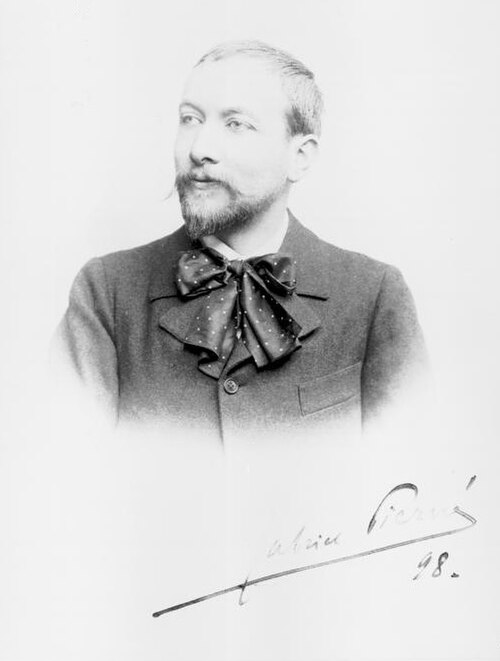

Gabriel Pierné
1863 — 1937
Henri Constant Gabriel Pierné was a French composer, conductor, pianist and organist.
Adapted from the Wikipedia article on Gabriel Pierné.
From the period sources
Gabriel Pierné, born in Metz in 1863, was a distinguished student at the Paris Conservatory, where he studied with Marmontel, César Franck, and Massenet. His academic career was marked by notable success, as he secured the first piano prize in 1879, followed by similar honors for counterpoint and fugue in 1881, and for organ in 1882. The same year, he was awarded the prestigious Grand Prix de Rome, according to A Biographical Dictionary of Musicians (1900). A significant appointment came in 1890 when Pierné succeeded his former teacher, César Franck, as organist at Ste.-Clothilde.
Pierné’s compositional output included several stage works, such as the five-act spectacle Bouillon d’Or (1893), the four-act opera Izeyl (1894), and the three-act lyric drama Vendée, which premiered in Lyons in 1897 to “moderate success,” as noted in A Biographical Dictionary of Musicians (1900). He also composed Le docteur Blanc, with a libretto by Catulle Mendès (1900). His opera Izeyl featured a libretto by Armand Silvestre, who also penned texts for composers like Saint-Saëns and Massenet, according to A Biographical Dictionary of Musicians (1905). Later, Mary Garden sang at the premiere of Pierné’s La Fille du Tabarin in 1901, as recorded in The New Encyclopedia of Music and Musicians (1924). Pierné’s oratorio, The Children’s Crusade, was performed in America by the Apollo Musical Club of Chicago (1920) and the Arion Club of Providence (1920). Famous Composers and Their Works (1891) places Pierné among the “young composers” contributing to the “remarkable vitality” of the French musical school at the end of the nineteenth century, noting a trend for musicians to seek concert approbation before turning to the theatre. He was considered part of the “old school” of song composers, indebted to Gounod, according to Grove’s Dictionary of Music and Musicians (American Supplement) (1922). Pierné also played a role in the rediscovery of Ernest Fanelli’s impressionistic compositions, bringing them to attention in 1912, as detailed in The New Encyclopedia of Music and Musicians (1924).