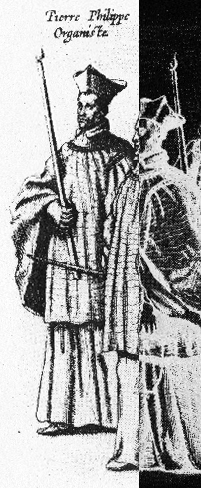

Peter Philips
1561 — 1628
Peter Philips was an eminent English composer, organist, and Catholic priest exiled to Flanders in the Spanish Netherlands. He was one of the greatest keyboard virtuosos of his time, and transcribed or arranged several Italian motets and madrigals by such composers as Lassus, Palestrina, and Giulio Caccini for his instruments. Some of his keyboard works are found in the Fitzwilliam Virginal Book. Philips also wrote many sacred choral works.
Adapted from the Wikipedia article on Peter Philips.
From the period sources
Peter Philips, an English composer born of Catholic parents around 1560, spent much of his career on the continent, settling in Béthune in his youth as an organist, according to Fétis in Biographie universelle des musiciens (1837). Around 1595, he journeyed to Italy, residing in Rome for several months, before moving to Antwerp. There, he served as organist to Archdukes Albert and Isabella, later obtaining a canonry at Soignies, where he was still living in 1623 (Biographie universelle des musiciens, 1837). Philips often adopted the Italian name Pietro Philippi or Filippi for his works.
His compositions include madrigals, such as those in the Melodia Olimpica (Antwerp, 1594), a collection he published featuring various eminent musicians, and his own Il primo libro de’ Madrigali a sei voci (Antwerp, 1596) and Madrigali a Otto voci (Antwerp, 1598), the latter dedicated to Sir William Stanley (Biographie universelle des musiciens, 1837; Grove’s Dictionary, 1904). Sacred works include Cantiones sacrae for five and eight voices (Antwerp, 1612, 1613) and Litaniae B. M. V. (Antwerp, 1623), as noted in Biographie universelle des musiciens (1837). His instrumental music, such as an elaborate “Galiarda Passamezzo” dated 1592, is found in the Fitzwilliam Virginal Book (Grove’s Dictionary, 1904). Philips also used Alessandro Striggio’s madrigal “Chi fara fed’ al cielo” as a theme for a fantasia (Grove’s Dictionary, 1908).