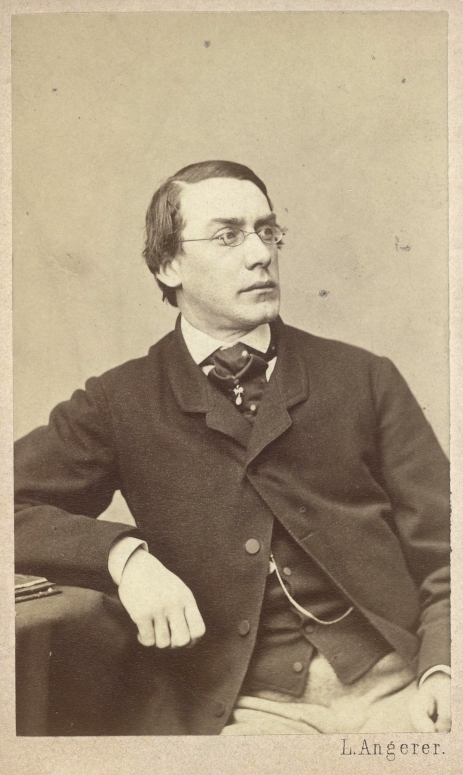

Ernst Pauer
1826 — 1905
Ernst Pauer was an Austrian pianist, composer and educator.
Adapted from the Wikipedia article on Ernst Pauer.
From the period sources
Ernst Pauer, a pianist and composer, was born in Vienna in 1826 and settled in London after marrying Miss Andrea of Frankfort-on-the-Main in 1852, according to the Cyclopedia of Music and Musicians (1890). He had studied under Theodor Dirzka, Wolfgang Amadeus Mozart the younger, and Sechter in Vienna, and later Franz Lachner in Munich. Pauer became director of musical societies in Mainz in 1847 and achieved success as a performer in London in 1851. He was made Austrian court pianist in 1866 and, from 1870, lectured on music history in Great Britain and Ireland, succeeding Cipriani Potter at the Royal Academy of Music and becoming a professor at the National Training School for Music at Kensington Gore in 1876. The Cyclopedia (1890) notes that Hanslick called him “the first pastor of German music in London.”
Pauer was also a significant editor and educator. He published editions of classical composers, including “Alte Klavier-Musik,” “Alte Meister,” and “Old English Composers for the Virginals and Harpsichord,” which included pieces by John Bull, William Byrd, and Thomas Augustine Arne, as noted in A Biographical Dictionary of Musicians (1900, 1905) and Dictionary of Music (1896, 1908). His editorial work extended to classical composers from Bach and Handel to Schumann for Augener’s edition, and he compiled a “New Gradus ad Parnassum” with one hundred studies, some his own. As a teacher, he instructed notable figures like Eugene d’Albert, who studied pianoforte with him at the National Training School in 1876 (A Biographical Dictionary of Musicians, 1900, 1905), and Friedrich Gernsheim, who was his pupil in Mainz (Cyclopedia of Music and Musicians, 1889). Pauer’s own compositions included operas such as Don Riego (Mannheim, 1849) and Die rothe Maske (Mannheim, 1850), a Symphony in C minor, and various piano pieces and songs, alongside arrangements of Schumann’s symphonies and Mendelssohn’s piano concertos (Cyclopedia of Music and Musicians, 1890). He also contributed to The Monthly Musical Record (1907) and authored theoretical works like “Primer of the Pianoforte” and “Elements of the Beautiful in Music” (1876), and “Primer of Musical Forms” (1878) (Cyclopedia of Music and Musicians, 1890).