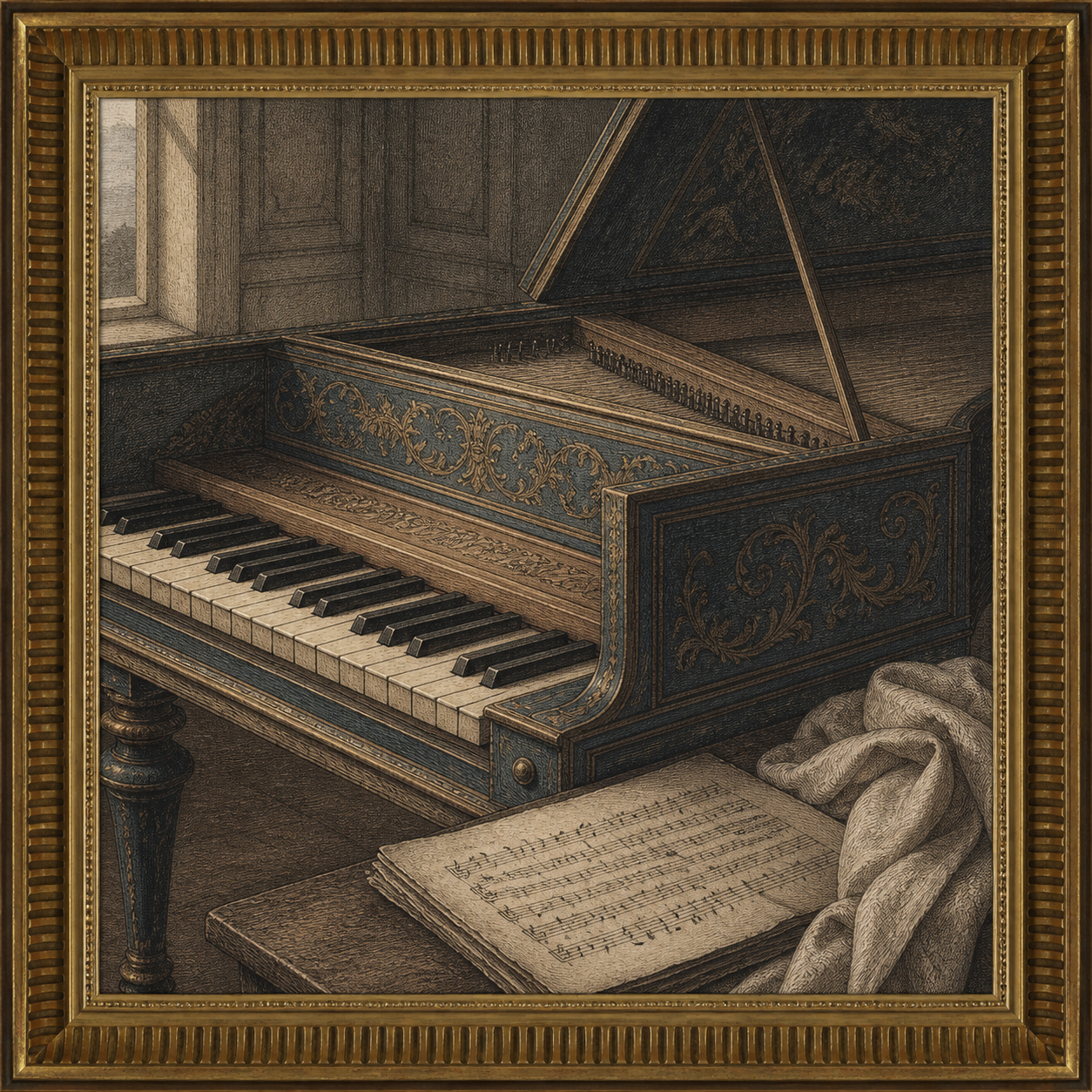
Bernardo Pasquini
1637 — 1710
Bernardo Pasquini was an Italian composer of operas, oratorios, cantatas and keyboard music. A renowned virtuoso keyboard player, he was one of the most important Italian composers for harpsichord between Girolamo Frescobaldi and Domenico Scarlatti, having also made substantial contributions to opera and oratorio.
Adapted from the Wikipedia article on Bernardo Pasquini.
From the period sources
Bernardo Pasquini was a prominent Italian organist and composer in the latter half of the seventeenth century, born in Massa di Valnevola, Tuscany, on December 8, 1637 (Biographie universelle des musiciens, Vol. 7, 1837; Cyclopedia of Music and Musicians, Vol. 2, 1889; Grove’s Dictionary, Vol. 1, 1904). He studied music under Loreto Vittori and Antonio Cesti, but his profound knowledge was chiefly attributed to his diligent study of Palestrina’s works (Biographie universelle des musiciens, Vol. 7, 1837; Grove’s Dictionary, Vol. 1, 1904). Pasquini settled in Rome while still young, where he became organist at Santa Maria Maggiore and later held the title of organist to the Roman Senate and people, also serving as chamber musician to Prince Jean-Baptiste Borghese (Biographie universelle des musiciens, Vol. 7, 1837; Cyclopedia of Music and Musicians, Vol. 2, 1889; Grove’s Dictionary, Vol. 1, 1904). His reputation was such that Emperor Leopold sent several musicians to his school for instruction, and among his notable pupils were Francesco Gasparini and Francesco Durante (Biographie universelle des musiciens, Vol. 7, 1837; A Biographical Dictionary of Musicians, 1900; A Biographical Dictionary of Musicians, 2nd ed., 1905; Dictionary of Music, 1896; Dictionary of Music, 1908). Johann Philip Krieger also improved himself by Pasquini’s harpsichord instructions in Rome (A General History of the Science and Practice of Music, Vol. 2, 1875).
Pasquini was recognized as a “great dramatic composer” (A General History of the Science and Practice of Music, Vol. 2, 1875). In 1679, he composed the music for the opera Dov’ è amore e pietà for the opening of the Teatro Capranica, where he accompanied at the harpsichord while Corelli led the first violins (Biographie universelle des musiciens, Vol. 7, 1837; Grove’s Dictionary, Vol. 1, 1904). Mattheson, observing the Roman orchestra, noted Pasquini at the harpsichord alongside Corelli leading the band and Gaetani on the lute (A General History of the Science and Practice of Music, Vol. 2, 1875; Grove’s Dictionary, Vol. 1, 1904). He also composed a musical drama in 1686 in honor of Queen Christina of Sweden, for which Corelli led 150 string instruments (A General History of the Science and Practice of Music, Vol. 2, 1875; Biographie universelle des musiciens, Vol. 7, 1837; Grove’s Dictionary, Vol. 1, 1904). Pasquini’s music is described as “terse, vigorous, and at the same time graceful,” sharing “much in common with Handel,” and exerting “a certain amount of influence upon German musicians” (Grove’s Dictionary, Vol. 1, 1904). His compositions include harpsichord pieces found in collections such as Toccates et suites pour le clavecin (Amsterdam, 1704), an opera La forza d’amore, and an oratorio La sete di Cristo (Biographie universelle des musiciens, Vol. 7, 1837; Cyclopedia of Music and Musicians, Vol. 2, 1889; Grove’s Dictionary, Vol. 1, 1904). He died in Rome on November 22, 1710, and his monument in the church of S. Lorenzo in Lucina was erected by his nephew Bernard Ricordati and his pupil Bernard Gaffi (Biographie universelle des musiciens, Vol. 7, 1837; Grove’s Dictionary, Vol. 1, 1904).