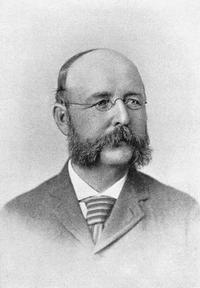

John Knowles Paine
1839 — 1906
John Knowles Paine was the first American-born composer to achieve fame for large-scale orchestral music. The senior member of a group of composers collectively known as the Boston Six, Paine was one of those responsible for the first significant body of concert music by composers from the United States. The Boston Six’s other five members were Amy Beach, Arthur Foote, Edward MacDowell, George Chadwick, and Horatio Parker.
Adapted from the Wikipedia article on John Knowles Paine.
From the period sources
John Knowles Paine, born in Portland, Maine, in 1839, received his early musical training from H. Kotzschmar in his native city, making his public debut as an organist in 1857. He then pursued studies in Berlin from 1858 to 1861, focusing on organ, singing, and instrumentation under Haupt, Fischer, Wieprecht, and Teschner, according to Dictionary of Music (1896) and Grove’s Dictionary (1908). Upon returning to the United States in 1861, Paine continued to give organ concerts and teach, becoming an instructor in music at Harvard University in 1862, a position that evolved into a newly created professorship of music by 1876 (Dictionary of Music, 1896). John Fiske, quoted in Famous Composers and Their Works (1891), noted that Paine transformed this role from “little more than that of organist and choirmaster” or “teaching singing school” into something more substantial.
Paine’s influence extended through his teaching, with notable pupils including William Foster Apthorp, who studied piano, harmony, and counterpoint with him from 1863-1867 (A Biographical Dictionary of Musicians, 1900), and Milo Ellsworth Benedict, who studied theory (Cyclopedia of Music and Musicians, 1888). Charles Dupee Blake and Samuel Brenton Whitney also studied with Paine (Cyclopedia of Music and Musicians, 1888; Famous Composers and Their Works, 1891). While his earliest compositions were classical in spirit, his later works, from about Opus 22, adopted a romantic character (Dictionary of Music, 1896). His significant compositions include the oratorio St. Peter (1873), a grand Mass in D (1867), and several symphonies, such as the Symphony in C minor (Op. 23, 1876) and the Symphony in A, “Spring” (Op. 34, 1880), both produced in Boston (Dictionary of Music, 1896). Paine also composed incidental music for Sophocles’s Oedipus Tyrannus, first performed under his direction, and the cantata The Nativity (Op. 38, 1883), based on Milton’s ode (Cyclopedia of Music and Musicians, 1890). Grove’s Dictionary (1922) recognized him as “the first composer of musical scholarship” in America, noting that while he paid little heed to song himself, his numerous pupils achieved distinction in that form.