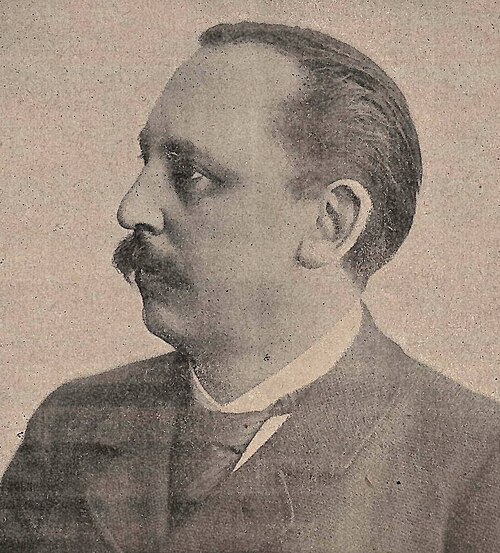

Max Meyer-Olbersleben
1850 — 1927
Max Meyer-Olbersleben was a German composer and pianist.
Adapted from the Wikipedia article on Max Meyer-Olbersleben.
From the period sources
Max Meyer-Olbersleben, born in Olbersleben, Weimar, in 1850, was recognized as a “gifted composer” by the Dictionary of Music (1896, 1908). He served as a teacher at the Royal School of Music at Würzburg, a role he began in 1877 and from which he rose to become director of the institution between 1907 and 1920, according to The New Encyclopedia of Music and Musicians (1924). This same source notes that he also conducted the “noted Liedertafel” and, from 1896, held a position as an officer in the Deutscher Sängerbund. Since 1885, he bore the title of royal professor. Meyer-Olbersleben’s compositional output included two operas, Clare Dettin (1896) and the comic Der Haubenkrieg (1902), along with overtures like Feierklange and Festouvertüre, and the symphonic poem Sonnenhymnus. His chamber music included a piano-trio, a viola-sonata, a flute-sonata, and three ‘cello-pieces. He also composed numerous choruses, both for mixed voices and specifically for men’s voices (totaling about 40 such works), some 60 songs, and approximately 35 “highly original piano-pieces,” as detailed in The New Encyclopedia of Music and Musicians (1924). His training included studies with Miller-Hartung, Liszt, and at the Munich Conservatory. Notably, he was also a teacher to James Francis Cooke, who studied with him and Hermann Ritter at the Royal Conservatory in Würzburg, as recorded in Grove’s Dictionary of Music and Musicians: American Supplement (1920).