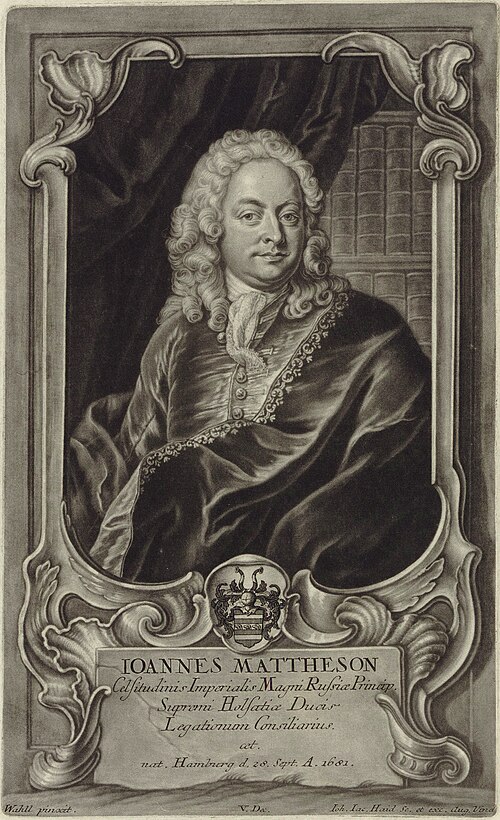

Johann Mattheson
1681 — 1764
Johann Mattheson was a German composer, critic, lexicographer and music theorist. His writings on the late Baroque and early Classical period were highly influential, specifically, “his biographical and theoretical works were widely disseminated and served as the source for all subsequent lexicographers and historians”.
Adapted from the Wikipedia article on Johann Mattheson.
From the period sources
Johann Mattheson, a German composer and writer, was a significant figure in Hamburg’s musical life, serving as a singer in the city’s theatre from 1697 and later as Secretary of Legation in 1706, Canon of the cathedral in 1715, and Chapel-master to the Duke of Holstein in 1719, according to A Biographical Dictionary of Musicians (1886). Though his own musical productions are now largely forgotten, the same dictionary notes he was “a person of considerable acquirements, and a musician of no mean ability.” Mattheson was a contemporary and friend of Handel, with whom he became acquainted in 1703, and their friendship lasted until late 1704, as recounted in Biographie universelle des musiciens et bibliographie générale de la musique, Vol. 4 (1883). This source details a dramatic incident on December 5, 1704, during a performance of Mattheson’s opera Cléopâtre, where Handel, playing the harpsichord, refused to yield his place to Mattheson, who had finished his role as Antony. This led to a violent sword fight in the street, only resolved when Mattheson’s sword broke against a large metal button on Handel’s chest. The two were later reconciled, and Handel attended a rehearsal of his own opera Almira at Mattheson’s invitation just weeks later.
Mattheson was also a prolific writer on music, publishing works such as Das neu-eroffnete Orchestre (1713-21) and Der Vollkommene Capellmeister (1739), which are cited across various reference works. His writings offer valuable insights into his contemporaries: he applauded Andreas Hammerschmidt’s “zeal for the glory of God” in his motets, as noted in A General History of the Science and Practice of Music, Vol. 2 (1875), and ascribed to Johann Jacob Froberger the remarkable ability to represent historical events on the organ through an “imitative faculty,” even detailing how Froberger depicted Count Thum’s perilous passage over the Rhine with “twenty-six cataracta or falls in notes” (A General History of the Science and Practice of Music, Vol. 2, 1875). He also recorded that Martin Agricola was the first to abandon old tablature for modern notation (A Biographical Dictionary of Musicians, 1900). Mattheson’s Neu eroffnetes Orchester was notably attacked by Johann Heinrich Buttstedt in his pamphlet Ut, re, mi, fa, sol, la, tota musica et harmonia aeterna, which Mattheson then refuted with his Beschütztes Orchester (1717), according to A Biographical Dictionary of Musicians (2nd ed.) (1905). His Grundlage einer Ehrenpforte (1740) is frequently referenced for biographical details of other musicians, and he even published a biography of Handel in 1761 (Biographical Dictionary of Musicians, 1886).