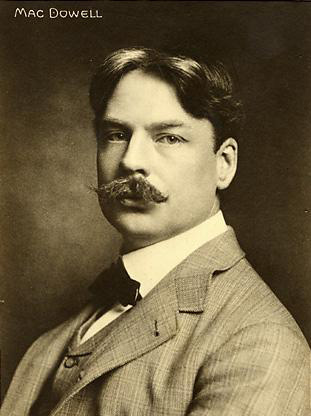

Edward MacDowell
1860 — 1908
Edward Alexander MacDowell was an American composer and pianist of the late Romantic period. He was best known for his second piano concerto and his piano suites Woodland Sketches, Sea Pieces and New England Idylls. Woodland Sketches includes his most popular short piece, “To a Wild Rose”. In 1904 he was one of the first seven Americans honored by membership in the American Academy of Arts and Letters.
Adapted from the Wikipedia article on Edward MacDowell.
From the period sources
Edward MacDowell, a noteworthy pianist and composer, received his early training in New York from teachers including Teresa Carreño, before pursuing extensive studies in Europe. From 1876, he was a pupil at the Paris Conservatoire, studying pianoforte with Marmontel and theory with Savard (A Biographical Dictionary of Musicians, 1900). He later moved to Germany, studying composition under Joachim Raff and piano under Carl Heymann in Frankfort (Cyclopedia of Music and Musicians, 1889). Grove’s Dictionary (1904) highlights Raff’s profound influence, noting that the “admiration which he felt for Raff’s music, and the attachment which sprang up between master and pupil were among the strongest influences which shaped his creative career.”
MacDowell’s works gained early recognition in Germany; in 1882, the support of Raff and Liszt secured a hearing for his compositions at the “Allgemeiner deutscher Musikverein” festival in Zurich, where he performed his First Pianoforte Suite (A Biographical Dictionary of Musicians, 1900; Grove’s Dictionary, 1904). After returning to America in 1888, he settled in Boston, and by 1896, was appointed professor of music at Columbia University in New York, a position he resigned in 1904 due to “disagreement with the faculty touching the proper footing of music and the fine arts in the curriculum” (Grove’s Dictionary, 1904). Grove’s American Supplement (1922) justly places him as “the first place among American song-writers,” noting his “distinct personality” and “cultivated musician” qualities, with popular songs like ‘Thy beaming eyes’ and ‘The robin sings in the apple-tree’.