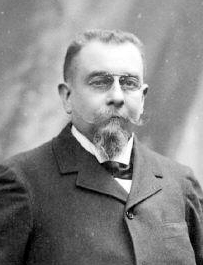

Albert Lavignac
1846 — 1916
Alexandre Jean Albert Lavignac was a French music scholar, known for his essays on theory, and a minor composer.
Adapted from the Wikipedia article on Albert Lavignac.
From the period sources
Albert Lavignac, a distinguished figure at the Paris Conservatoire, was born in Paris on January 22, 1846, according to Grove’s Dictionary of Music and Musicians (1906), which also records his impressive student career. He was a pupil of the Conservatoire, where he earned the first prize for solfège in 1857, for piano in 1861, and for harmony and composition in 1863. He also secured the first prize for counterpoint and fugue in 1864, and the second for organ in 1865. Lavignac later became professor of solfège in 1882 and professor of harmony in 1891. His 1882 publication, “Cours complet theorique et pratique de dictee musicale,” was a landmark work, described by A Biographical Dictionary of Musicians (1900) as having “caused the adoption of courses in musical dictation in leading music-schools throughout the world.” Indeed, The New Encyclopedia of Music and Musicians (1924) notes that while the importance of dictation was recognized earlier, Lavignac’s work marked a significant separate treatment of the subject. Beyond his pedagogical influence, Lavignac also authored “La musique et les musiciens” (1895) and contributed an essay on tablatures to his own Encyclopédie de la Musique (The New Encyclopedia of Music and Musicians, 1924). His notable pupils included Paul Marie Vincent d’Indy and Claude Debussy, who studied harmony with him (Dictionary of Music, 1896; Grove’s Dictionary, 1906; Grove’s American Supplement, 1920).