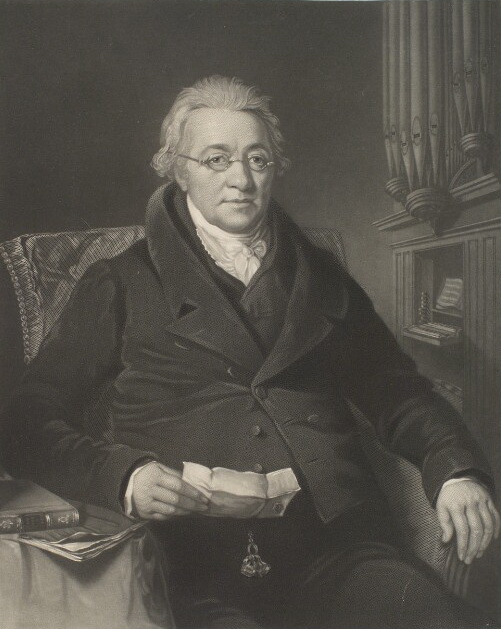

Christian Ignatius Latrobe
1758 — 1836
Christian Ignatius Latrobe was an English clergyman of the Moravian Church, as well as an artist, musician and composer. He created a large number of works for, and most famously edited, a Selection of Sacred Music in six volumes between 1806 and 1826, introducing the sacred music of Haydn, Mozart and Pergolesi and other European continental composers who were largely unknown to English audiences.
Adapted from the Wikipedia article on Christian Ignatius Latrobe.
From the period sources
The Reverend Christian Ignatius Latrobe, born in Fulneck near Leeds in 1758, cultivated music assiduously from an early age, though he never pursued it as a profession, according to Grove’s Dictionary (1906). He studied at the college of the United Brethren at Niesky, Upper Lusatia, and later took orders in the same church, becoming secretary to the Unity of the Brethren in England by 1796. Latrobe’s early compositions were primarily instrumental, and notably, three of his sonatas received Haydn’s approval, leading to their publication with a dedication to the esteemed composer (Grove’s Dictionary, 1906). His other published works include Lord Roscommon’s translation of the “Dies Irae” (1799), “The Dawn of Glory” (1803), an Anthem for the Jubilee of George III (1809), and “Six Airs on serious subjects” with words by Cowper and Hannah More.
Latrobe’s most significant contribution, however, was his “Selection of Sacred Music from the works of the most eminent composers of Germany and Italy,” a six-volume collection published between 1806 and 1826 (Grove’s Dictionary, 1906). This monumental work was crucial in introducing many fine modern compositions to the British public. He also edited the first English edition of the Moravian Hymn Tunes. His son, John Antes Latrobe, followed in his footsteps as an English writer and organist, publishing “The Music of the Church” in 1831 and “Instructions of Chenaniah” in 1832, a guide for accompanying chants and psalm tunes (Biographical Dictionary of Musicians, 1886).