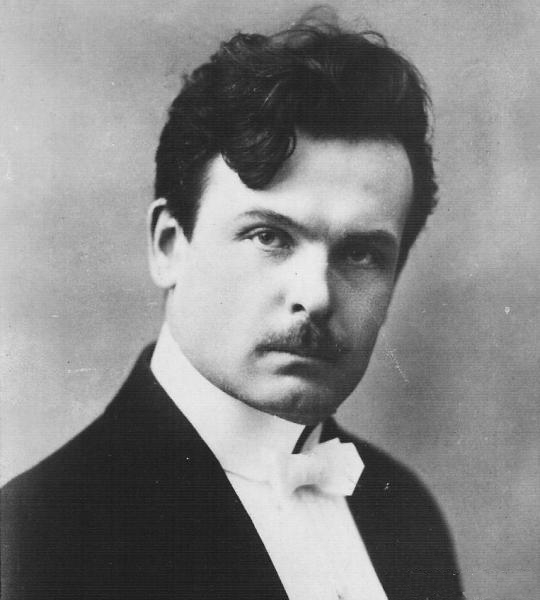

Toivo Kuula
1883 — 1918
Toivo Timoteus Kuula was a Finnish composer and conductor of the late-Romantic and early-modern periods, who emerged in the wake of Jean Sibelius, under whom he studied privately from 1906 to 1908. The core of Kuula’s oeuvre are his many works for voice and orchestra, in particular the Stabat mater, The Sea-Bathing Maidens (1910), Son of a Slave (1910), and The Maiden and the Boyar’s Son (1912). In addition he also composed two Ostrobothnian Suites for orchestra and left an unfinished symphony at the time of his murder in 1918 in a drunken quarrel.
Adapted from the Wikipedia article on Toivo Kuula.
From the period sources
Toivo Kuula was an able Finnish composer whose training included studies at the Helsingfors Conservatory and with teachers such as Bossi, Sitt, and Labey, according to The New Encyclopedia of Music and Musicians (1924). His career as a conductor began in 1910 with the orchestra at Uleaborg, and he later served as an assistant with the Helsingfors Philharmonic in 1913-14, followed by a position at Wiipuri. Kuula’s compositional output encompassed a symphonic poem, two orchestral suites, a piano-trio, and a violin-sonata. He also wrote three cantatas, two Legends for voice and orchestra, a cappella choruses, songs, and piano-pieces.