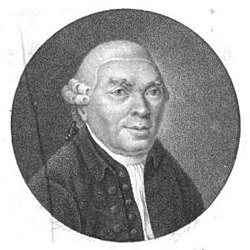

Johann Christoph Kühnau
1660 — 1722
Johann Kuhnau was a German polymath, known primarily as a composer today. He was also active as a novelist, translator, lawyer, and music theorist, and was able to combine these activities with his duties in his official post as Thomaskantor in Leipzig, which he occupied for 21 years. Much of his music, including operas, masses, and other large-scale vocal works, is lost. His reputation today rests on his Biblical Sonatas, a set of programmatic keyboard sonatas published in 1700, in which each sonata depicted in detail a particular story from the Bible. After his death, Kuhnau was succeeded as Thomaskantor by Johann Sebastian Bach.
Adapted from the Wikipedia article on Johann Kuhnau.
From the period sources
Johann Christoph Kühnau, born in Geysingen, the son of a fisherman, rose to become an eminently learned and skillful musician, ultimately serving as organist of St. Thomas at Leipsic from 1684 and later as Director Musices of the university in 1700, a post he held until his death in 1722, when he was succeeded by Johann Sebastian Bach (A General History, 1875; A Biographical Dictionary of Musicians, 1900). His reputation extended beyond music; Ernest Wilhelm Hertzog, a German count palatine, celebrated Kühnau in a 1722 discourse, extolling his skill “in Theologia, in Jure, in Oratorio, in Poesi, in Algebrae et Mathesi, in Linguis exoticis, et in Re Musicâ” (A General History, 1875).
Kühnau is widely recognized for his contributions to clavier music, particularly his sonatas. According to Famous Composers and Their Works (1891), he was “the first to give form to the sonata as an independent form,” a claim echoed by A Biographical Dictionary of Musicians (1886). His “Fresh Clavier Fruits; or, Seven Sonatas of good Invention and adapted to the Clavier” (1696) and “Biblische Historien” (1700) are noted as early examples of program music (Famous Composers, 1891; Grove’s Dictionary, 1904). The latter, six sonatas for organ and clavier, vividly depicted scenes such as “The Combat of David and Goliath” and “The Melancholy of Saul cured by Music,” complete with detailed explanations (Grove’s Dictionary, 1904). While some later critics, like Wagner, viewed such descriptive music as an “abuse” (Famous Composers, 1891), Kühnau’s works are seen as illustrating a curious transition in the evolution of instrumental music, bridging fugal habits of thinking with nascent ideas of abstract music and tonal form (Grove’s Dictionary, 2nd ed., 1908). He also published a tract titled “The Musical Quacksalver” in 1700 to counter “clamours of some ignorant men of his profession, who envying his merit and reputation, had libelled him” (A General History, 1875). Among his notable pupils were Johann David Heinichen and Johann Friedrich Fasch (Cyclopedia of Music and Musicians, 1889; A Biographical Dictionary of Musicians, 1900).