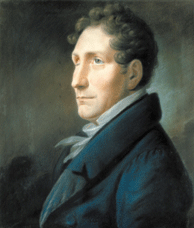

Friedrich Kuhlau
1786 — 1832
Friedrich Daniel Rudolf Kuhlau, sometimes written as Frederick Kulav, was a Danish pianist and composer during the late Classical and early Romantic periods. He was a central figure of the Danish Golden Age and is immortalized in Danish cultural history through his music for Elves’ Hill, the first true work of Danish National Romanticism and a concealed tribute to the absolute monarchy.
Adapted from the Wikipedia article on Friedrich Kuhlau.
From the period sources
Friedrich Kuhlau, a Hanoverian by birth, fled to Copenhagen in 1810 to avoid French conscription, where he became a royal chamber-musician without salary in 1813, eventually earning the title of court composer in 1818 and Professor in 1828 (Dictionary of Music, 1896, 1908). He studied harmony under Schwencke in Brunswick (Dictionary of Music, 1896, 1908) and was later a teacher to Niels Peter Jensen (The New Encyclopedia of Music and Musicians, 1924). Kuhlau was considered one of the three founders of the Danish school of music, alongside C. E. F. Weyse and J. Hartmann, despite his German origins (Grove’s Dictionary, 1908). He was particularly celebrated as a composer for the flute, earning him the moniker “the Beethoven of the Flute” (A Dictionary of Music and Musicians, 1879). This specialization was reportedly due to a wealthy amateur flutist who liberally commissioned his works, which included numerous solos, duets, trios, and quartets for the instrument (A Dictionary of Music and Musicians, 1879). His instrumental compositions, especially piano sonatinas, were still popular and valued for their educational use for beginners in the late 19th century (Dictionary of Music, 1896, 1908). However, by 1886, a biographical dictionary noted that this “once-famous composer is now scarcely recognised save as a writer for the Pf. His fine songs and larger works are alike neglected” (Biographical Dictionary of Musicians, 1886). In 1825, Kuhlau visited Vienna, where he had a memorable encounter with Beethoven, who, after a jovial evening, penned a canon as a playful pun on Kuhlau’s name: “Kühl, nicht lau” (A Dictionary of Music and Musicians, 1880; Grove’s Dictionary, 1904). Sadly, Kuhlau suffered the loss of many valuable manuscripts in a fire in 1830, a calamity that, along with the death of his parents, undermined his health and contributed to his premature death in 1832 (A Dictionary of Music and Musicians, 1880; Cyclopedia of Music and Musicians, 1889).