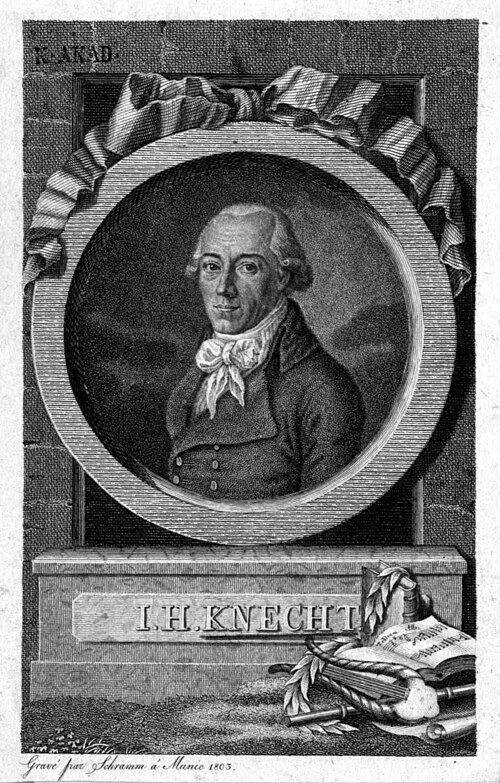

Justin Heinrich Knecht
1752 — 1817
Justinus or Justin Heinrich Knecht was a German composer, organist, and music theorist.
Adapted from the Wikipedia article on Justin Heinrich Knecht.
From the period sources
Justin Heinrich Knecht, born in Biberach, Württemberg, in 1752, was a figure of considerable reputation in his day, known as an organist, composer, and theoretician (A Dictionary of Music and Musicians, 1880). He served as organist and music director in his native Biberach from 1771 to 1807, also holding a professorship of literature there (Grove’s Dictionary, 1906; Biographical Dictionary of Musicians, 1886). Knecht was considered a rival to Abbé Vogler at the organ, with some contemporaries even deeming him superior as a composer and theorist (A Biographical Dictionary of Musicians, 1900).
In 1807, Knecht moved to Stuttgart to become court Kapellmeister and director of the opera and court concerts, but he resigned by 1809, returning to Biberach due to “intrigues” (Dictionary of Music, 1908; Cyclopedia of Music and Musicians, 1889). As a theorist, he was an adherent of Vogler’s school, notably representing “the extreme school of third-building up to the chords of the eleventh, on all degrees of the scale” (Dictionary of Music, 1896). His compositions, though now largely forgotten, include a symphony titled “Le Portrait Musical de la Nature,” which shares a programmatic scheme with Beethoven’s Pastoral Symphony, though “beyond the titles the resemblances… are obviously casual” (Grove’s Dictionary, 1906). Knecht also collaborated with Johann Friedrich Christmann on a “Vollständige Sammlung” of hymns for Württemberg (A Biographical Dictionary of Musicians, 1900).