A guide to
Sigfrid Karg-Elert
Oberndorf am Neckar 1877 — Leipzig 1933
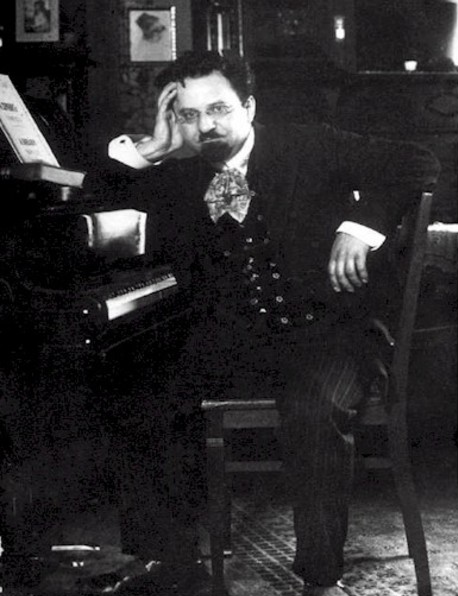
Sigfrid Karg-Elert was the great chromatic outsider of German organ music — a composer admired far more abroad than at home, who wrote some of the most richly coloured organ music of the early twentieth century and then watched his own country turn away from it. He spent his last decades in Leipzig, the city of Bach, and his late masterpiece weaves Bach’s own name into a passacaglia; yet his sympathies ran to Debussy and Scriabin, and the German organ world of the 1920s, marching back toward a leaner neo-Baroque, found him too perfumed. England and America heard him better.
He was born in Oberndorf am Neckar on 21 November 1877 as plain Siegfried Karg, and his family moved to Leipzig in 1882. He trained at the Leipzig Conservatory under Carl Reinecke, Salomon Jadassohn and others, and around 1901, while teaching in Magdeburg, he refashioned himself: he adopted the Swedish spelling “Sigfrid” and added “Elert,” a variant of his mother’s maiden name Ehlert, to make the resonant double-barrelled name he kept for the rest of his life.
The harmonium years
A decisive turn came in 1904, when the Berlin publisher Carl Simon introduced him to the harmonium — the reed organ — and to its sophisticated concert cousin, the Kunstharmonium. Karg-Elert fell in love with the instrument’s capacity for swelling dynamics and subtle voicing, and went on to build one of the largest and most serious bodies of original harmonium music ever written. From 1924 he gave weekly harmonium recitals broadcast from his own home over Leipzig radio. The harmonium’s expressive shading — its ability to bend a chord’s colour by breath alone — left a permanent mark on how he heard the organ.
His early piano work had been encouraged, the sources record, by Edvard Grieg himself, and the influences Karg-Elert absorbed read like a roll-call of everything the conservative German organ loft distrusted: Bach and Grieg, yes, but also Debussy, Scriabin and the early Schoenberg. His own idiom he described frankly as late-Romantic, with impressionist and expressionist leanings — stretching tonal harmony to its limit without ever quite letting it snap.
The organ works
His reputation as an organ composer rests on a handful of remarkable collections. The 66 Chorale Improvisations, Op. 65 (1909) were his first major original organ work — Lutheran chorale tunes dressed in a harmonic language no German organist had brought to them before, of which the “Marche triomphale” on Nun danket alle Gott remains a recital favourite. The Cathedral Windows, Op. 106 — published in London in 1923 — take plainchant and liturgical melodies and refract them through what the composer called “polychrome” harmony, his ear oscillating between clean diatony and dense chromatic colour: the organ as a wall of stained glass.
The crowning work is the Passacaglia and Fugue on B-A-C-H, Op. 150, written in 1931 and dedicated to the English organ-builder Henry Willis III; it received its first performance at the Johanniskirche in Leipzig. That a composer steeped in French impressionism should close his life by spelling out Bach’s name in the bass of a monumental passacaglia is the perfect emblem of his divided allegiance — modern colour poured into the oldest German mould.
A prophet abroad
The strange shape of Karg-Elert’s career is its most telling fact. While “almost completely overlooked in his native Germany,” as one modern study puts it, he was prized in Britain and the United States. In 1930 the Organ Music Society of London mounted a festival of his music, which he travelled over to attend — the high point of his public life. The sequel was crueller. In 1932 he undertook a concert tour of America as a performing organist, and it went badly: ill with diabetes, and a far better composer than he was a player, he disappointed audiences expecting a virtuoso, and recitals were cancelled as word spread.
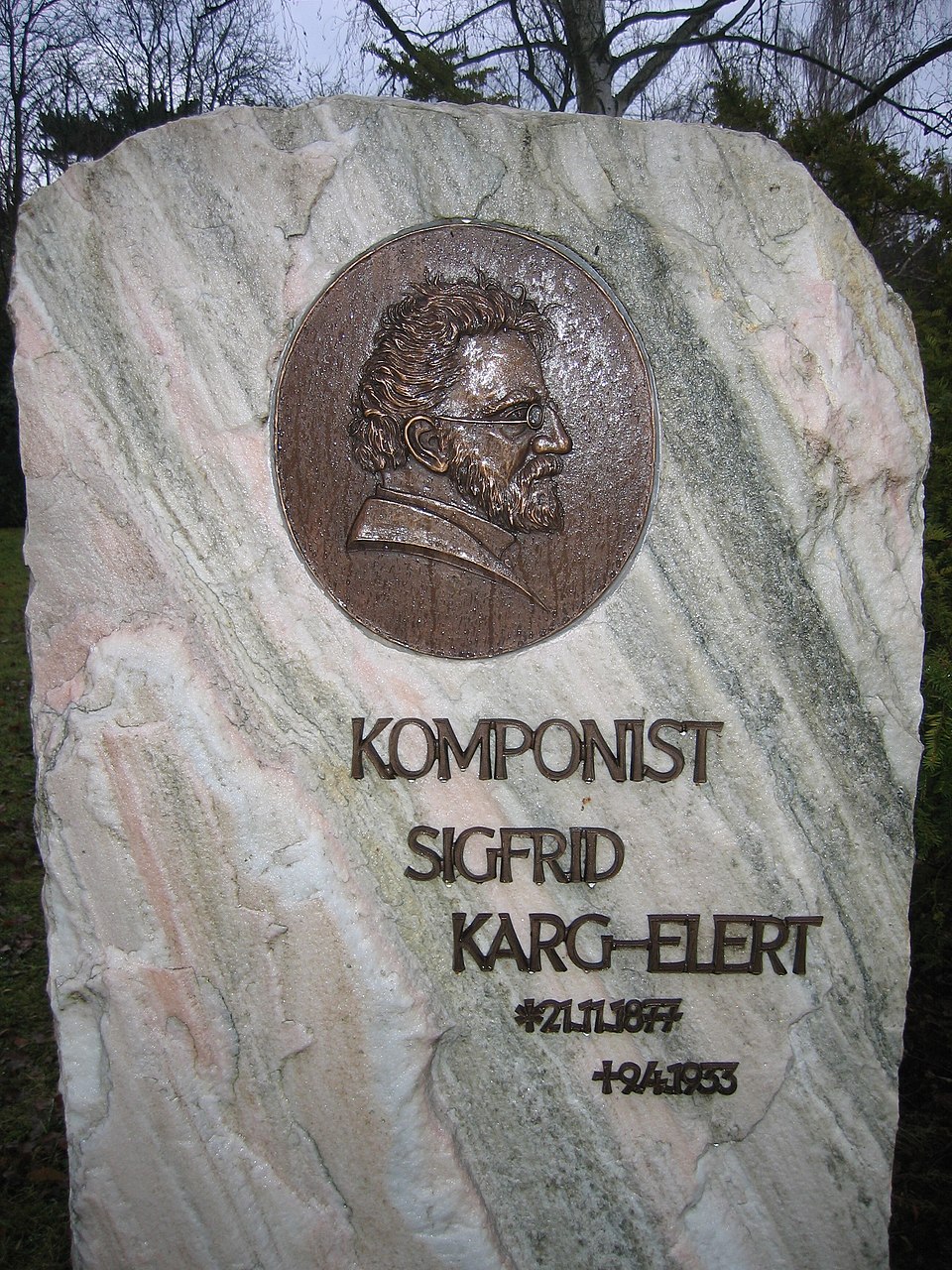
He returned to Leipzig and died there on 9 April 1933, aged fifty-five, and is buried in the city’s South Cemetery. For decades afterward his music lay neglected, caught on the wrong side of fashion — too chromatic for the neo-Baroque revival, too rooted in the chorale for the avant-garde. The recording era has slowly restored him: the chorale improvisations, the Cathedral Windows, the B-A-C-H Passacaglia, and the vast harmonium output now stand revealed as the work of one of the most original harmonic imaginations the organ ever knew.