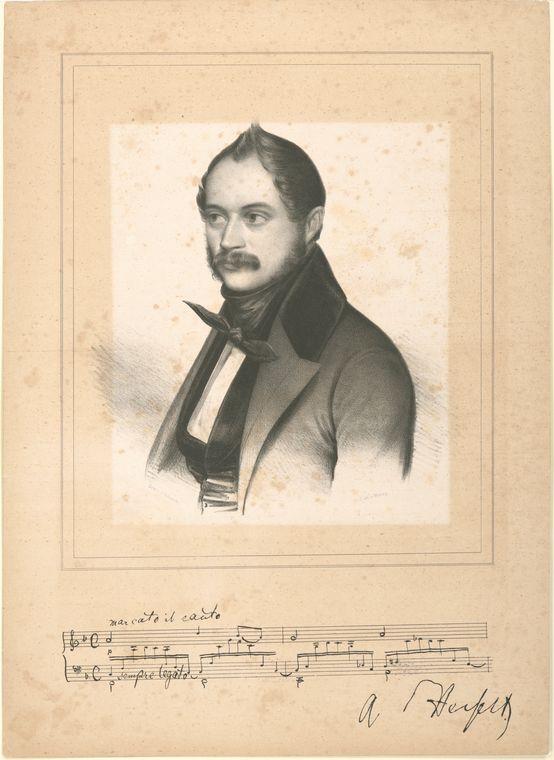

Adolf von Henselt
1814 — 1889
Georg Martin Adolf von Henselt was a German composer and virtuoso pianist.
Adapted from the Wikipedia article on Adolf von Henselt.
From the period sources
Adolf von Henselt, a pianist and composer of remarkable talent, was born in Schwabach, Bavaria, in 1814. His family moved to Munich when he was three, where he initially studied violin before turning to the piano under an obscure teacher named Lasser. His early promise, however, captured the interest of Madame von Flad, wife of a privy councillor, who had herself studied with Meyerbeer and Carl Maria von Weber. This “remarkable pianist and distinguished composer of instrumental music” guided Henselt’s musical education until he was seventeen, imparting a brilliant and correct execution along with preliminary harmony notions, as recorded in Fétis’s Biographie universelle des musiciens (1883).
Henselt’s teachers also included Ludwig Berger, a distinguished pianist and composer, who taught him alongside Mendelssohn and Taubert (A Biographical Dictionary of Musicians, 1900). Later, King Ludwig I provided an allowance for Henselt to study with Hummel in Weimar, though Henselt had already developed his own original playing method. After eight months with Hummel, he spent two years in Vienna studying counterpoint with Sechter and practicing piano. His playing, noted for its poetic and inspired character, particularly of Hummel and Weber, was often reserved for private circles due to his natural nervousness and shyness before large audiences, according to Cyclopedia of Music and Musicians (1889). Indeed, this source recounts an anecdote from a St. Petersburg concert where Henselt, playing from the green-room, forgot to remove his cigar before rushing on stage, smoking through the first movement of a concerto, oblivious to the Emperor and court.
He settled in St. Petersburg in 1838, becoming chamber pianist to the Empress and Prince von Oldenburg, and later inspector of musical instruction in government girls’ schools. His F minor concerto, Op. 16, was long considered the most difficult piano piece, and his two sets of Studies, Op. 2 and Op. 5, are described as “quite unique” (Cyclopedia of Music and Musicians, 1889). Robert Schumann, who dedicated his Novelletten (Op. 21) to Henselt, recognized him as one of the “most illustrious composers of his generation” (Grove’s Dictionary of Music and Musicians, 2nd ed., 1908). Henselt also prepared a selection of Johann Baptist Cramer’s celebrated “84 Studies” with a second piano accompaniment, which became a standard work in pianistic pedagogics (A Biographical Dictionary of Musicians, 1900). Among his notable pupils was Alfred Heinrich Ehrlich, an eminent pianist and author (A Biographical Dictionary of Musicians, 2nd ed., 1905). Henselt died in Warmbrunn, Silesia, in 1889 (Cyclopedia of Music and Musicians, 1890).