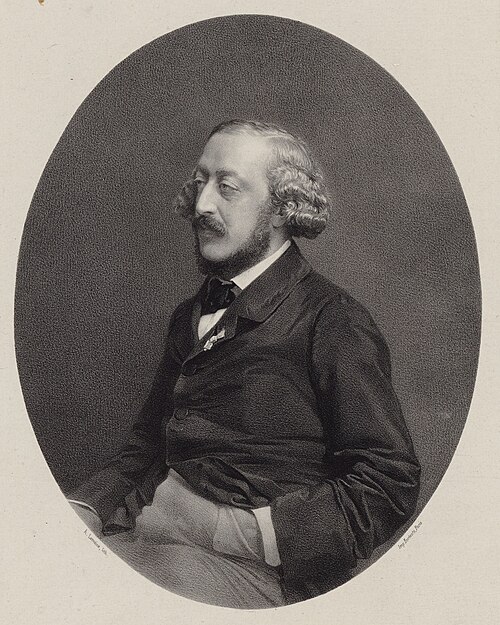

Stephen Heller
1813 — 1888
Stephen Heller was a Hungarian pianist, teacher, and composer whose career spanned the period from Schumann to Bizet. Heller was an influence for later Romantic composers. He outlived his reputation, and was a near-forgotten figure at his death in 1888.
Adapted from the Wikipedia article on Stephen Heller.
From the period sources
Stephen Heller, a pianist and composer for his instrument, was born in Pesth on May 15, 1814, though one source, Schiadebach and Bernsdorf’s Lexique universel de musique, suggests 1815. His father initially intended him for a legal career, but Heller’s musical talent became evident early, leading him to study with Brauer and later, briefly, with Charles Czerny in Vienna, before becoming a pupil of M. A. Halm. At the age of nine, Heller performed Dussek’s concerto for two pianos with his teacher at the Pesth theatre, and by 1827-28, he was giving public concerts in Vienna (Biographie universelle des musiciens, 1883; Dictionary of Music, 1896, 1908).
A significant turning point occurred during a concert tour in 1829 when Heller fell ill in Augsburg. There, he was taken in by “art-loving families” and settled, leaving in 1848 as “a man of ripe views and ability” (Dictionary of Music, 1896, 1908). His early harmony lessons were received from the old organist Cibulka in Pesth, who gave Heller his first instruction in the art of writing music (Biographie universelle des musiciens, 1883; Cyclopedia of Music and Musicians, 1888). Heller later became a regular contributor to the Revue et Gazette musicale (Grove’s Dictionary, 1922, 1908), and his compositions, exclusively for pianoforte and numbering over 150, were praised by Schumann in the Neue Zeitschrift für Musik even while Heller was still in Augsburg (Dictionary of Music, 1896, 1908). His works are described as “light, pleasing efforts, with some originality and much careful, as well as skilful, elaboration,” placing him in the same school as Ascher (Biographical Dictionary of Musicians, 1886).