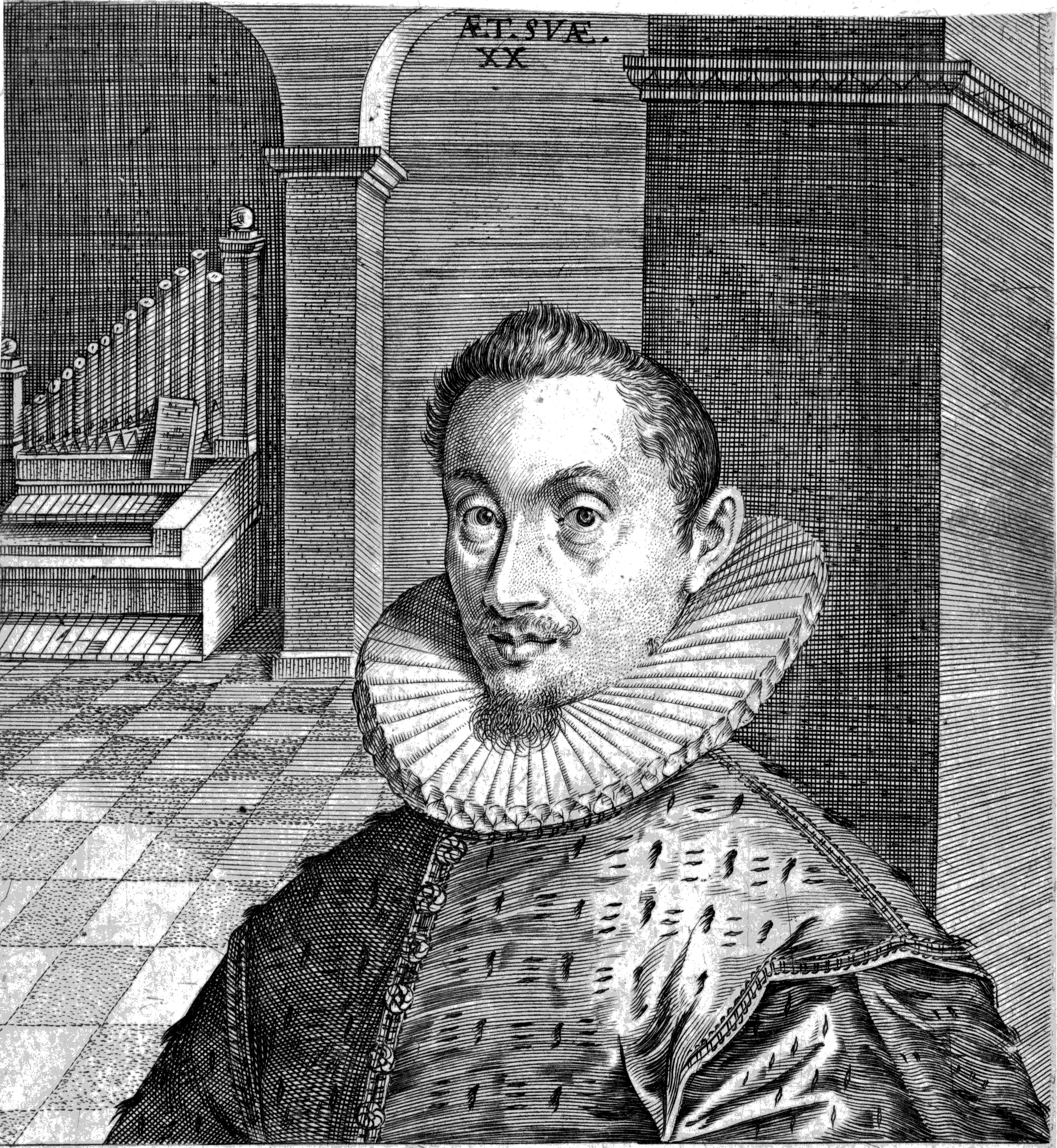

Hans Leo Hassler
1564 — 1612
Hans Leo Hassler was a German composer and organist of the late Renaissance and early Baroque eras, elder brother of lesser known composer Jakob Hassler. He was born in Nuremberg and died in Frankfurt.
Adapted from the Wikipedia article on Hans Leo Hassler.
From the period sources
Hans Leo Hassler, the eldest of three sons of Isaac Hassler, a Nuremberg town-musician, received his initial training from his father. In 1584, Hassler journeyed to Venice, becoming the first notable German composer to study in Italy, where he was a pupil of Andrea Gabrieli, the renowned organist and founder of the Venetian school, according to A Biographical Dictionary of Musicians (1905). This Italian sojourn profoundly shaped his taste, with Biographie universelle des musiciens (1883) suggesting he likely studied Palestrina’s works, leading to a style purer than that of the Venetian school.
Upon his return, Hassler served as organist to Count Octavianus Fugger at Augsburg from 1585 to 1601. He then became court musician to Emperor Rudolf II in Prague, who ennobled him, before taking an appointment with the Elector of Saxony in 1608, as detailed in A Biographical Dictionary of Musicians (1905). Hassler is considered one of the founders of German music, alongside contemporaries like Gumpeltzhaimer and Franck, and his compositions, while influenced by the Gabrielis, possess a “genuine German simplicity and strength,” according to Famous Composers and Their Works (1891). His Lustgarten newer deutscher Gesang (1601) notably contained the melody for the chorale “O Haupt voll Blut und Wunden,” which Bach later famously used in his Passion music, as noted in Grove’s Dictionary (1922).