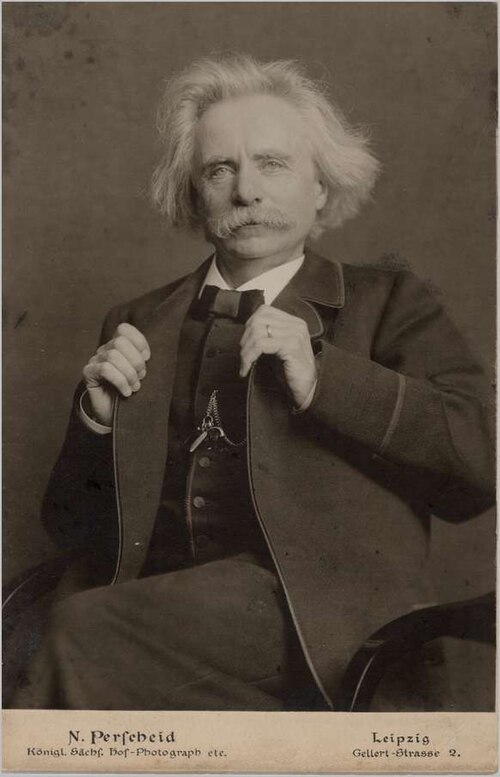

Edvard Grieg
1843 — 1907
Peer Gynt, Op. 23, is the incidental music to Henrik Ibsen’s 1867 play Peer Gynt, written by the Norwegian composer Edvard Grieg in 1875. It premiered along with the play on 24 February 1876 in Christiania. Grieg later created two suites from his Peer Gynt music. Some of the music from these suites has received coverage in popular culture.
Adapted from the Wikipedia article on Peer Gynt (Grieg).
From the period sources
Edvard Grieg, a Norwegian composer and pianist, received his initial musical instruction from his mother, a gifted pianist and woman of musical culture. At the suggestion of the celebrated violinist Ole Bull, Grieg entered the Leipzig Conservatory in 1858, where he studied harmony and counterpoint under Hauptmann and Richter, composition under Rietz and Reinecke, and piano with Wenzel and Moscheles (A Biographical Dictionary of Musicians, 1900, 1905, 1908). While the prevailing musical tone in Leipzig was set by Mendelssohn and Schumann, Grieg was “strong enough to preserve his Scandinavian individuality,” a quality he further developed in Copenhagen under Gade and E. Hartmann (A Biographical Dictionary of Musicians, 1900, 1905). A pivotal moment in his career was his close friendship with Rikard Nordraak, a young Norwegian composer, with whom Grieg embarked on a “crusade… against the effeminate Mendelssohnian-Gade Scandinavianism” (A Biographical Dictionary of Musicians, 1900, 1905). Nordraak’s premature death in 1866 cut short this shared endeavor, but Grieg continued to champion a distinctively national music, a trait that led Ernst Wilhelm Fritzsch to publish his works, thereby “practically promoted modern musical development” (A Biographical Dictionary of Musicians, 1900, 1905). Grieg’s importance, according to A Biographical Dictionary of Musicians (1900, 1905), lies in his ability to imbue his music with a “strong strain of Scandinavian tonality,” giving his works “marked racial characteristics” without innovations in form. His shorter piano pieces, such as the “delightful Humoresken,” and many of his songs, are noted for their poetic feeling and popularity.