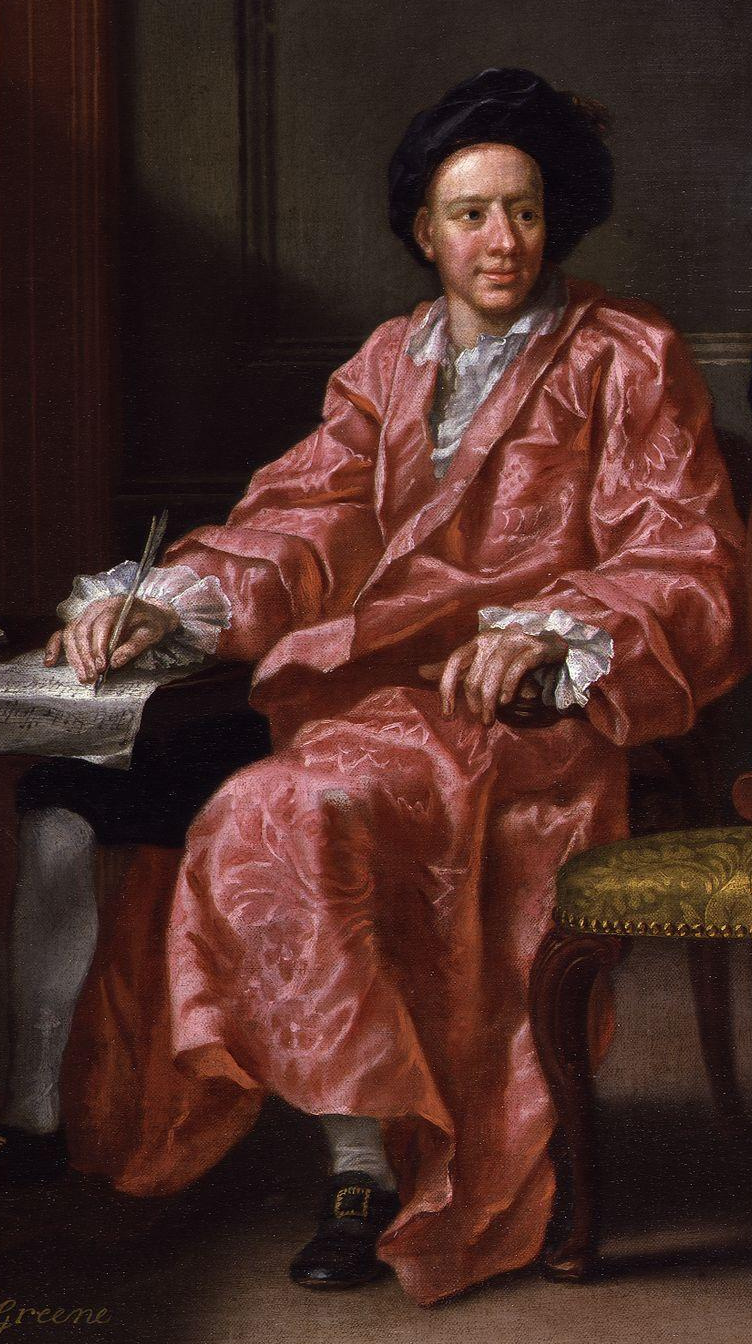

Maurice Greene
1696 — 1755
Maurice Greene was an English composer and organist. He was an admirer and friend of George Frideric Handel.
Adapted from the Wikipedia article on Maurice Greene (composer).
From the period sources
Maurice Greene, born in London in 1696, began his musical education as a chorister in St. Paul’s Cathedral under Charles King, later receiving organ lessons from Richard Brind, the cathedral’s organist, who is “best known as the teacher of Greene” (Brown’s Biographical Dictionary, 1886). Greene quickly distinguished himself, becoming organist of St. Dunstan’s at age twenty in 1716, and then succeeding Purcell as organist of St. Andrew’s, Holborn, in 1717. The following year, he obtained the prestigious organist position at St. Paul’s Cathedral, with a salary of fifty pounds sterling, upon Brind’s death (Fétis’s Biographie universelle des musiciens, 1883).
Greene’s career saw him rise to organist and composer of the Chapel Royal in 1727, and he earned his Doctor of Music degree from Cambridge University in 1730, composing Pope’s Ode for St. Cecilia’s Day as his exercise. He also became Professor of Music at Cambridge that same year, succeeding Dr. Tudway (Fétis, 1883). However, his character was not without controversy; Fétis (1883) describes him as a “mediocre man” who succeeded through “intrigue and flattery.” He was initially intimate with both Handel and Bononcini, but Handel, discovering Greene’s duplicity in denigrating one to the other, broke with him, leading Greene to become a vocal detractor of the illustrious master. Later, Greene’s conduct in the “unfortunate affair of the Madrigal of Lotti” with Bononcini made him so “odious” that he was forced to withdraw from the Academy of Music (Fétis, 1883). Despite these professional setbacks, a substantial inheritance from his uncle, Sergeant Greene, allowed him to live independently. He was also a co-founder of the Society of Musicians in 1738, established with Michael Christian Festing and others, for the support of impoverished musicians and their families (Grove’s Dictionary, 1906).