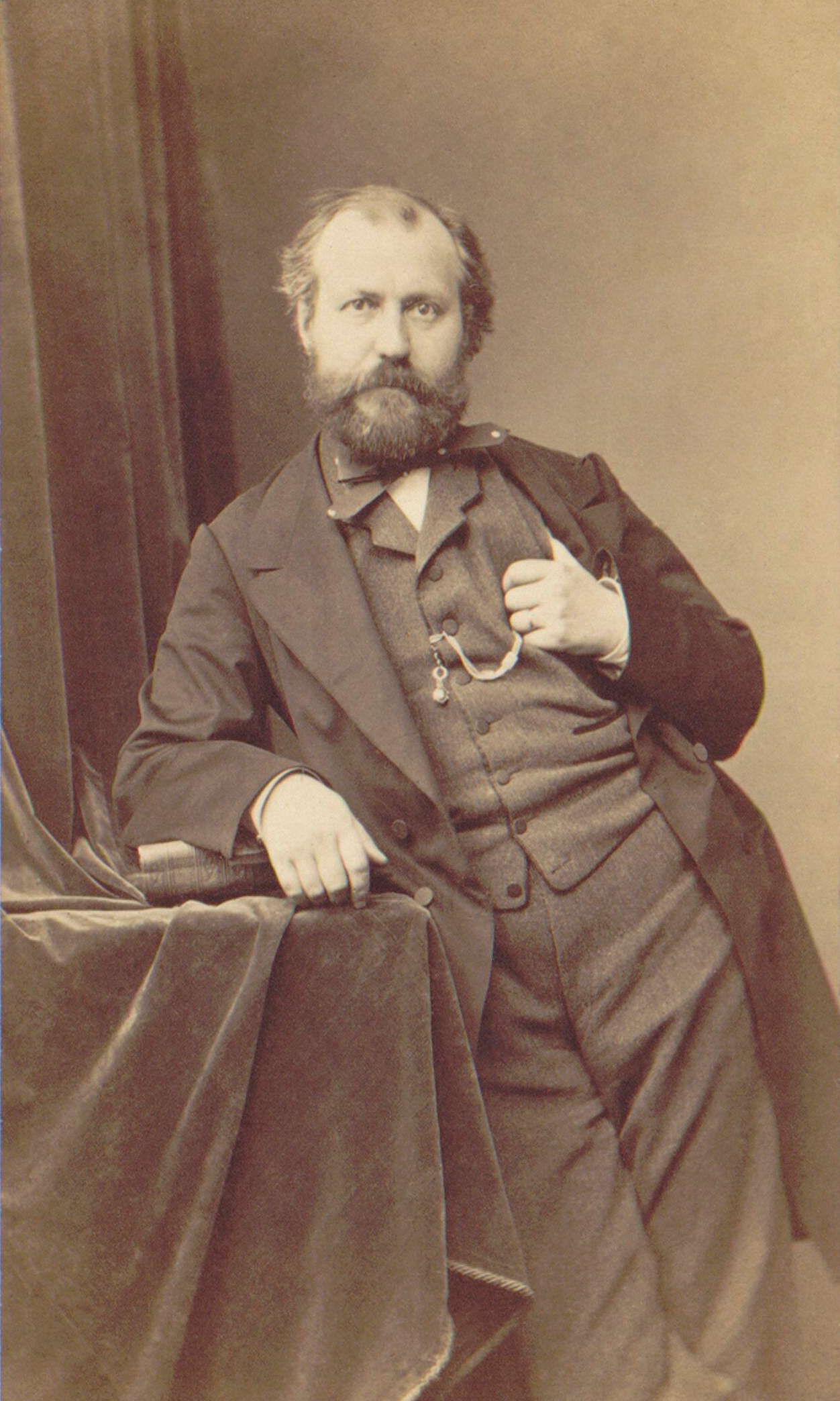

Charles Gounod
1818 — 1893
Charles-François Gounod was a French composer, conductor, and organist of the Romantic era. He wrote twelve operas, of which the most popular has always been Faust (1859); his Roméo et Juliette (1867) also remains in the international repertoire. He composed a large amount of church music, many songs, and popular short pieces including his “Ave Maria” and “Funeral March of a Marionette”.
Adapted from the Wikipedia article on Charles Gounod.
From the period sources
Charles Gounod received early training in counterpoint from Halévy at the Conservatoire between 1836 and 1838, and studied practical composition under Lesueur and Paër (Biographie universelle des musiciens, 1883). After winning the Grand Prix de Rome in 1839 for his cantata Fernand, he traveled to Rome, where he focused on church music. By 1843, in Vienna, he had a mass for unaccompanied voices, in the style of Palestrina, performed at St. Charles’s church. Returning to Paris, Gounod directed music at the Église des Missions étrangères and even wore ecclesiastical attire, leading the Gazette musicale de Paris (1846) to announce his entry into holy orders (Biographie universelle des musiciens, 1883).
His dramatic debut, Sapho, in 1851, did not meet expectations, partly due to a poor libretto and a perceived lack of unity in the score, though critics recognized “a sentiment of poetry” and “flashes of inspiration,” concluding Gounod was “an artist of the future” (Biographie universelle des musiciens, 1883). His most celebrated work, Faust, premiered in 1859, with Jules-Paul Barbier and Carre as librettists (A Biographical Dictionary of Musicians, 1900). While some found the roles of Faust and Mephistopheles incomplete, Marguerite’s role was deemed “of finished beauty,” and the third act, including “Salut, demeure chaste et pure,” was considered “the work of a first-rate talent” (Biographie universelle des musiciens, 1883). Notably, the Italian critic Francesco d’Arcais “constantly denied the value of Faust,” declaring it “not viable,” even after its widespread success across Italy, France, and Germany (Biographie universelle des musiciens, 1880). Gounod’s La Reine de Saba (1862) is remembered for its “beautiful Airs de ballet,” which contain “some of Gounod’s best music” (Grove’s Dictionary, 1922).