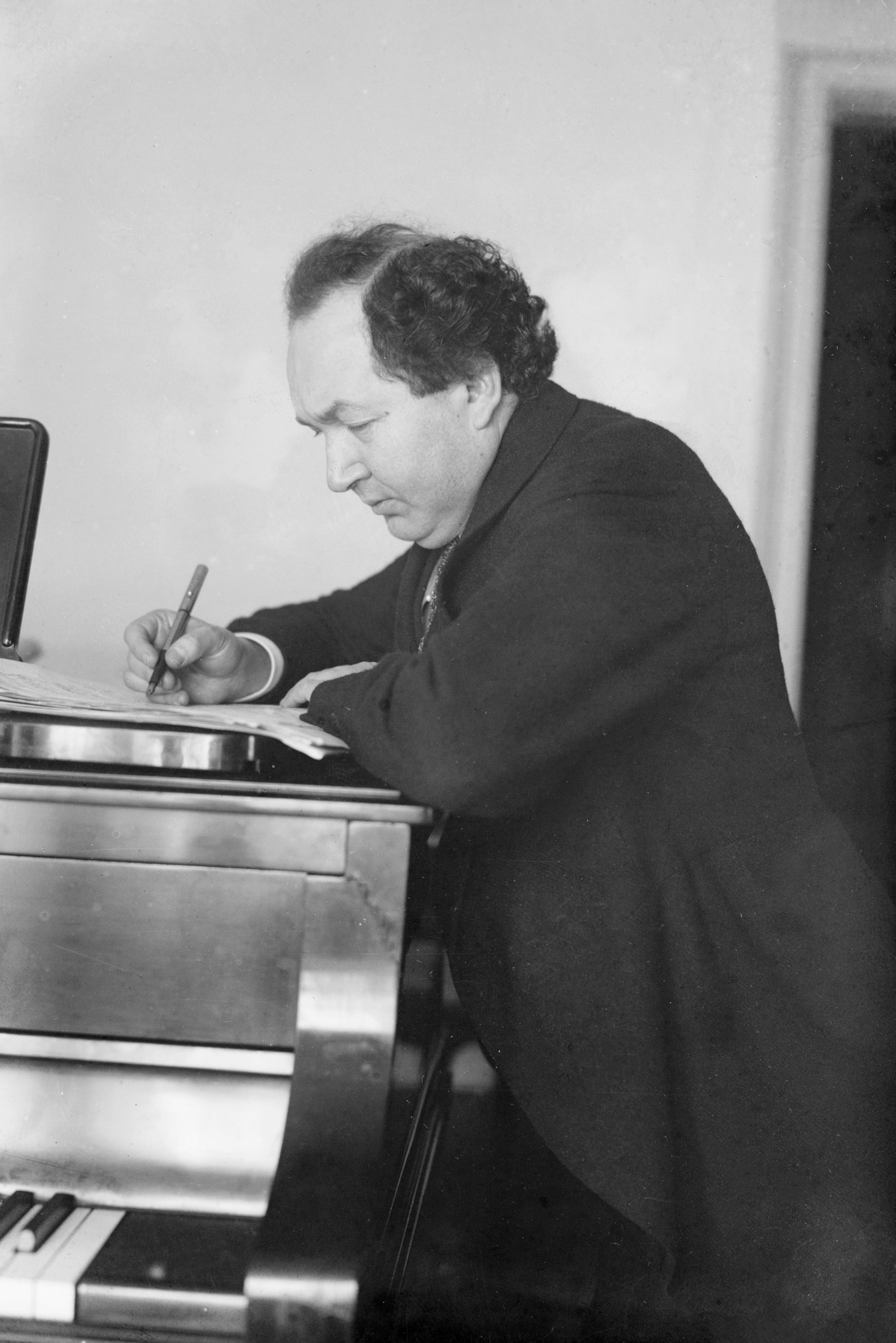
_in_1915.jpg)
Leopold Godowsky
1870 — 1938
Leopold Mordkhelovich Godowsky Sr. was a virtuoso pianist, composer and teacher, born in what is now Lithuania to Jewish parents, who became an American citizen in 1891. He was one of the most highly regarded performers of his time, known for his theories concerning the application of relaxed weight and economy of motion within pianistic technique – principles later propagated by his pupils, such as Heinrich Neuhaus.
Adapted from the Wikipedia article on Leopold Godowsky.
From the period sources
Leopold Godowsky, born in Wilna, Russian Poland, in 1870, displayed rare musical aptitude from the age of three, leading to an early and rapid development of his talents. His first public appearance as a pianist in his native town in 1879 was met with such emphatic success that a tour through Poland and Germany was arranged, according to Grove’s Dictionary (1906). At thirteen, a generous Königsberg banker enabled him to study at the Hochschule in Berlin with Bargiel and Rudorff. After two years, he returned to Europe, becoming a pupil of Saint-Saëns in Paris.
Godowsky made his first American tour in 1884-85 with violinist Ovide Musin, and after a successful visit to London in 1887-88, where he was commanded to appear at the British Court, he returned to America in 1890. He taught in Philadelphia from 1892 and in Chicago from 1894, where he also directed the Conservatoire (Grove’s Dictionary, 1906). His Berlin appearance on December 6, 1900, “set the seal upon his fame,” placing him “in the front rank of contemporary pianists,” a position he continued to strengthen. As a performer, he was noted for his mastery of tone-gradation, exquisite touch, and skill in manipulating many themes simultaneously. His compositions, though not numerous, include his fifty studies on Chopin’s ‘Études,’ described in Grove’s Dictionary (1906) as “really original compositions, not mere transcriptions, and are full of merit.” He also “freely arranged” a Minuetto and Allegro molto by Schobert in his ‘Renaissance’ (Grove’s Dictionary, 1922).