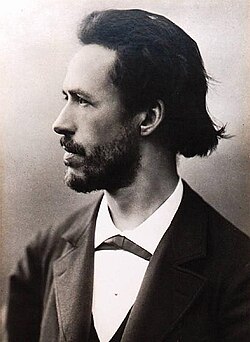

Benjamin Godard
1849 — 1895
Benjamin Louis Paul Godard was a French violinist and Romantic-era composer of Jewish extraction, best known for his opera Jocelyn. Godard composed eight operas, five symphonies, two piano and two violin concertos, string quartets, sonatas for violin and piano, piano pieces and etudes, and more than a hundred songs. He died at the age of 45 in Cannes (Alpes-Maritimes) of tuberculosis and was buried in the family tomb in Taverny in the French department of Val-d’Oise.
Adapted from the Wikipedia article on Benjamin Godard.
From the period sources
Benjamin Godard, born in Paris in 1849, began his musical studies early, learning violin under Richard Hammer and later Vieuxtemps, whom he accompanied twice to Germany, receiving “real encouragement to develop his talent as composer” (Dictionary of Music, 1896). He entered the Paris Conservatoire in 1863, studying harmony under Napoléon Henri Reber, described by a Biographical Dictionary of Musicians (1886) as “one of the best teachers ever connected with the Paris Conservatory.” Despite competing twice for the Prix de Rome without success, Godard left the Conservatoire in 1867 to dedicate himself to composition, also playing viola in various chamber music societies (Biographie universelle des musiciens, 1880; Grove’s, 1906).
His early career saw him orchestrate Schumann’s Kinderscenen in 1876 and gain the prize of the city of Paris in 1878 for his dramatic symphony Le Tasse (Grove’s, 1906; Dictionary of Music, 1896). This work, inspired by Goethe’s Tasso, was performed with much success at the Concerts du Châtelet (Grove’s, 1906). Godard was also a significant teacher, notably counting Cécile Chaminade among his composition pupils (Grove’s, 1905). Though a prolific composer, particularly of songs, Grove’s Dictionary (1906) noted a “too rapid productiveness and a too great leniency in judging his own works,” suggesting that his “undoubted talent” would have yielded “much more success had he known how to impose a stricter discipline upon his natural gifts.”