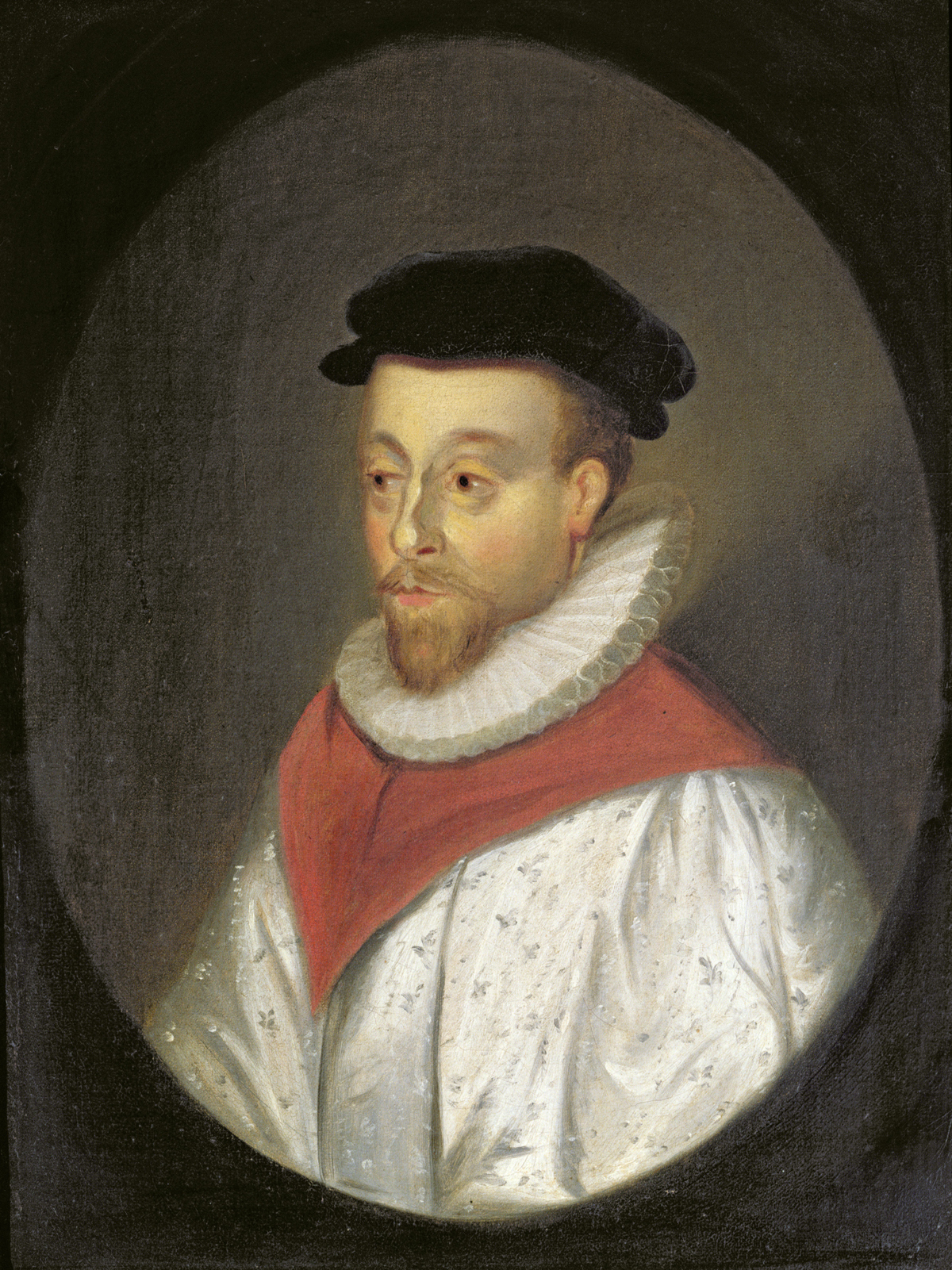
Portrait of Orlando Gibbons Historical portrait · sourceUnknown photographer · Public domain

A guide to

Orlando Gibbons

Oxford 1583 — Canterbury 1625
  1. 1583 Baptised in Oxford, 25 December
  2. 1596 Joins the choir of King's College, Cambridge, aged twelve
  3. 1605 Sworn a Gentleman and junior organist of the Chapel Royal
  4. 1612 Publishes the First Set of Madrigals and Motets, including 'The Silver Swan'
  5. 1613 Six keyboard pieces appear in Parthenia, the first printed English virginal music
  6. 1623 Appointed organist of Westminster Abbey
  7. 1625 Plays at the funeral of James I; dies suddenly at Canterbury, 5 June
Portrait of Orlando Gibbons
English School, portrait of Orlando Gibbons (oil on panel), Faculty of Music, Oxford. PD-Art, via Wikimedia Commons.

Orlando Gibbons was the last great master of the English virginalist school and, by the end of his short life, the leading keyboard player and church composer in England. Baptised in Oxford on 25 December 1583 into a large musical family — his father was a town wait, his brothers and his son all professional musicians — he was raised in Cambridge, where he joined the choir of King’s College in 1596. By 1605, in his early twenties, he was sworn a Gentleman and organist of the Chapel Royal, the centre of English court music, a post he held for the rest of his life.

His instrumental gift was famous in his own day. Contemporaries called him “the best hand in England” at the keyboard — and the verdict survives in the music: about forty-five keyboard pieces of unusual gravity and contrapuntal command, set apart from the dazzling figuration of his rivals by their weight and seriousness. Glenn Gould, who recorded the pavans and fantasias three centuries later, called Gibbons’s music the work that “has moved me more deeply than any other sound experience.”


Parthenia and the keyboard
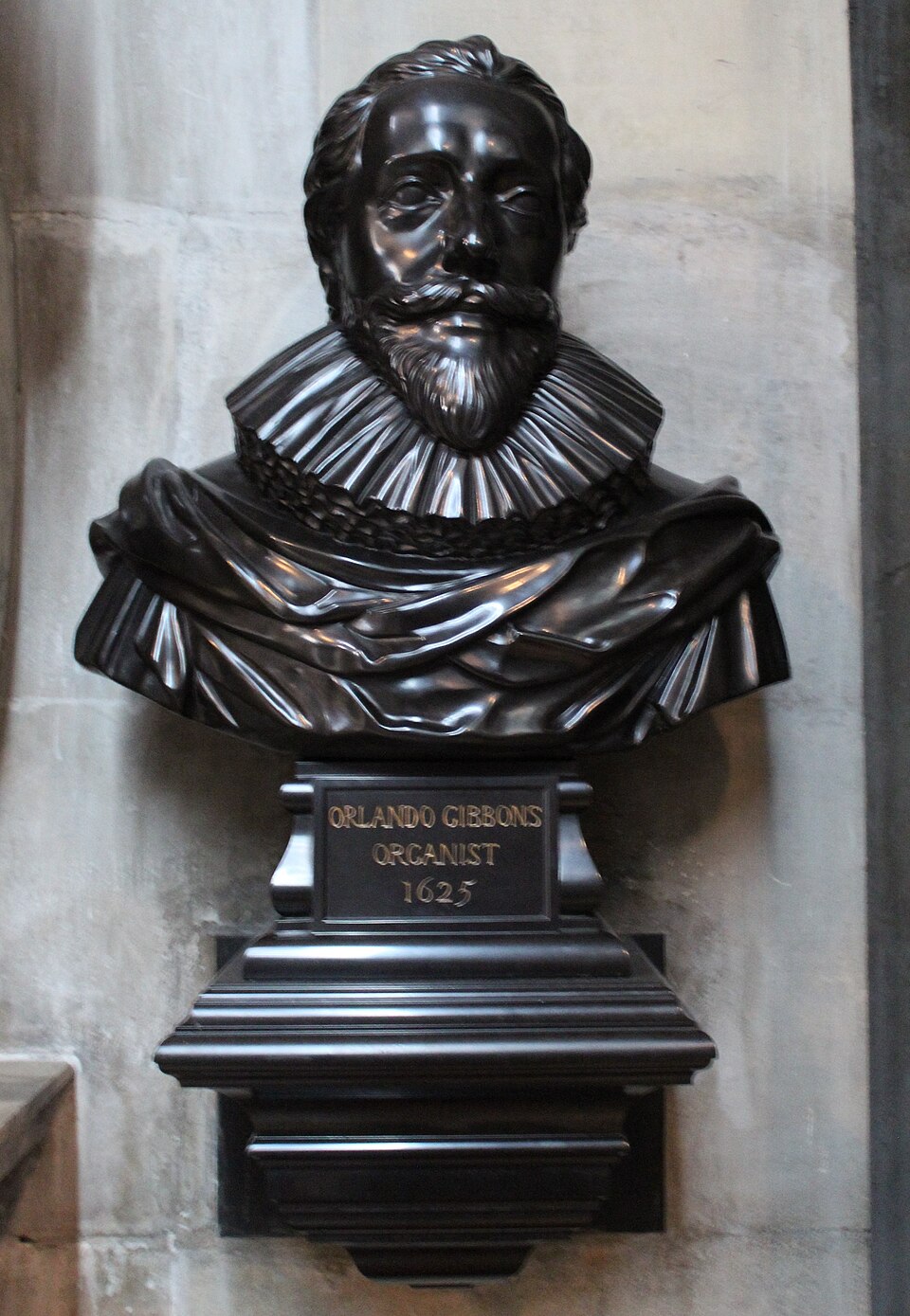
Bust of Orlando Gibbons in Westminster Abbey
Black marble bust of Orlando Gibbons in the north choir aisle of Westminster Abbey, London, where he was organist from 1623. Photograph via Wikimedia Commons.

In about 1612-13 appeared Parthenia, “the first musicke that ever was printed for the virginals” — a slim, beautifully engraved collection of twenty-one pieces by three composers, the aged William Byrd, John Bull, and Gibbons, all named on the title page as Gentlemen of the Chapel Royal. Gibbons’s six pieces, among them the famous Lord of Salisbury his Pavin, place the youngest of the three in the company of his elders as an equal. It is the foundation document of printed English keyboard music.

Beyond the keyboard, Gibbons wrote some thirty viol fantasias, a body of verse anthems — This is the Record of John, the eight-part O Clap Your Hands — that are pillars of the Anglican repertoire, and the haunting madrigal “The Silver Swan.” It is a remarkably varied output for a man who did not live to forty-two.


The sudden death at Canterbury
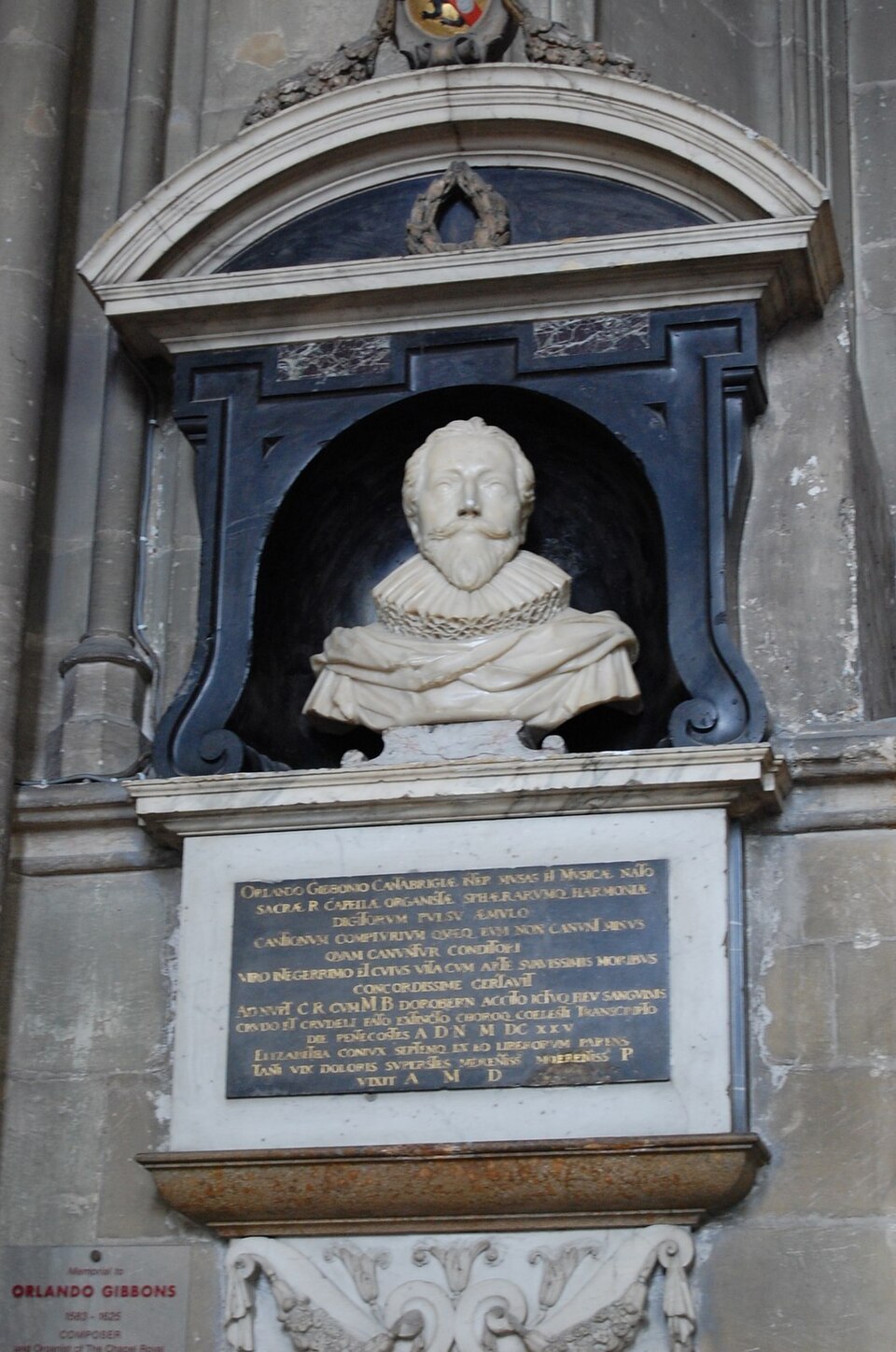
Memorial to Orlando Gibbons in Canterbury Cathedral
The memorial to Orlando Gibbons in Canterbury Cathedral, where he was buried in June 1625. Photograph via Wikimedia Commons.

In 1623 Gibbons added the organ of Westminster Abbey to his court duties, and it was in that role that he played at the funeral of James I early in 1625. That summer the Chapel Royal travelled to Canterbury to await the arrival from Dover of the new queen, Henrietta Maria, bride of Charles I. There, on Whitsunday, 5 June 1625, Gibbons collapsed and died — of an apoplectic seizure, a sudden brain haemorrhage — at the age of forty-one. The Chapel Royal cheque-book records it plainly: “Mr Orlando Gibbons organist, died the 5th of June, being then Whitsunday at Canterbury.”

He was buried in Canterbury Cathedral, where his widow raised the bust that still marks the spot. His son Christopher carried the family’s music into the next age — and taught the young Henry Purcell — so that the line ran on from the last virginalist into the English Baroque. Few composers have left so concentrated a body of fine music in so short a life.

All works (16)

one row per PDF across every work · semicolon-delimited

Undated works follow in catalogue order.Filter these works →

CatalogTitleInstrumentation
2 Pieces for Organ
Open individual scores (1)PDF on IMSLP ↗IMSLP work page ↗
Orgel 1 PDF Spotify Apple Music
A French Ayre
Open individual scores (1)PDF on IMSLP ↗IMSLP work page ↗
Orgel 1 PDF Spotify Apple Music
Almighty God, Which Hast Given
Open individual scores (1)PDF on IMSLP ↗IMSLP work page ↗
Bass, Orgel 1 PDF Spotify Apple Music
Complete Keyboard Works
Open individual scores (1)PDF on IMSLP ↗IMSLP work page ↗
Tasteninstrument 1 PDF Spotify Apple Music
Coranto, MB 39
Open individual scores (1)PDF on IMSLP ↗IMSLP work page ↗
Tasteninstrument 1 PDF Spotify Apple Music
French Coranto, MB 38
Open individual scores (1)PDF on IMSLP ↗IMSLP work page ↗
Tasteninstrument 1 PDF Spotify Apple Music
French Coranto, MB 39
Open individual scores (1)PDF on IMSLP ↗IMSLP work page ↗
Tasteninstrument 1 PDF Spotify Apple Music
In Nomine for keyboard
Open individual scores (1)PDF on IMSLP ↗IMSLP work page ↗
Cembalo 1 PDF Spotify Apple Music
Italian Ground
Open individual scores (1)PDF on IMSLP ↗IMSLP work page ↗
Tasteninstrument 1 PDF Spotify Apple Music
Out of the Deep
Open individual scores (1)PDF on IMSLP ↗IMSLP work page ↗
Bass, Orgel 1 PDF Spotify Apple Music
Pavana, FVB 292
Open individual scores (1)PDF on IMSLP ↗IMSLP work page ↗
Tasteninstrument (e.g. virginal, Cembalo, etc.) 1 PDF Spotify Apple Music
Preludium XIV
Open individual scores (1)PDF on IMSLP ↗IMSLP work page ↗
Cembalo 1 PDF Spotify Apple Music
Sarabande
Open individual scores (1)PDF on IMSLP ↗IMSLP work page ↗
Orgel 1 PDF Spotify Apple Music
The Fairest Nimphs
Open individual scores (1)PDF on IMSLP ↗IMSLP work page ↗
Tasteninstrument 1 PDF Spotify Apple Music
The Lady Hattons Galliard
Open individual scores (1)PDF on IMSLP ↗IMSLP work page ↗
Tasteninstrument 1 PDF Spotify Apple Music
Whoope doe Me No Harme Good Man
Open individual scores (1)PDF on IMSLP ↗IMSLP work page ↗
Tasteninstrument 1 PDF Spotify Apple Music