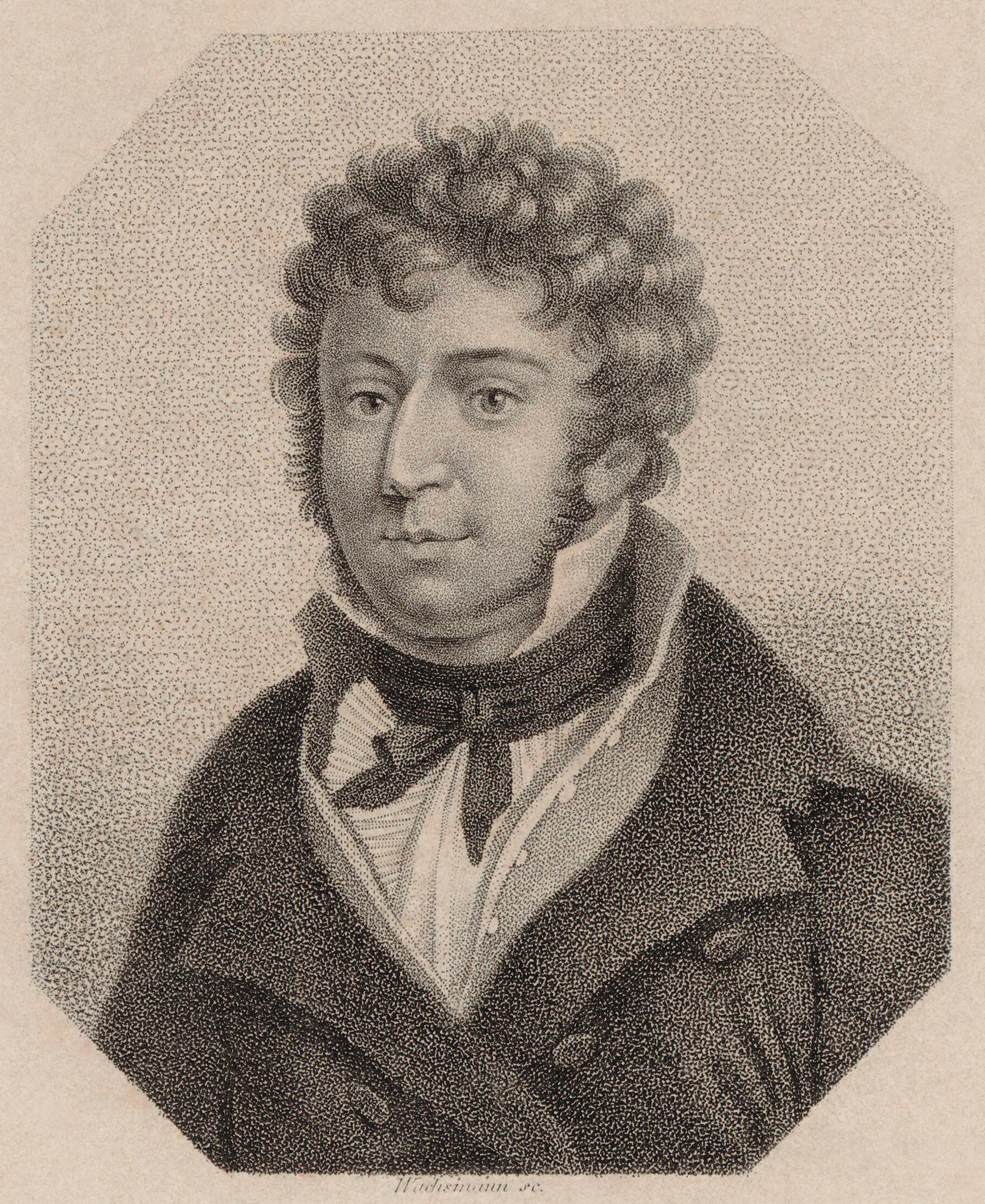

John Field
1782 — 1837
John Field was an Irish pianist, composer and teacher widely credited as the inventor of the nocturne. While many of his contemporaries wrote in a similar style, Field was the first to use the term to apply to a character piece featuring a cantabile melody over an arpeggiated accompaniment.
Adapted from the Wikipedia article on John Field (composer).
From the period sources
John Field, a prominent pianist of his era, was a favored pupil of Clementi, with whom he traveled to Paris in the autumn of 1802. There, Field “excited astonishment by the manner in which he played the fugues of Bach,” according to Fétis’s Biographie universelle des musiciens (1883). The two artists continued to Vienna in 1803, where Clementi intended for Field to study counterpoint with Albrechtsberger, but Field tearfully begged to accompany his master to St. Petersburg instead. Field’s playing style left a notable impression; Ludwig Berger, a piano teacher in Berlin whose pupils included Mendelssohn, was “strongly influenced by Field’s playing” (A Biographical Dictionary of Musicians, 1900). Similarly, Elisabeth Brendel, a distinguished pianist and teacher, was a “scholar of Field’s” and propagated his principles in her teaching (Grove’s Dictionary, 1922). However, not all contemporaries were equally impressed; Fétis (1883) records that Field, upon hearing Chopin around the same time, “judged him unfavorably, and declared that he was a talent for a sick-room.” Field’s compositions, particularly his Nocturnes, attracted the attention of Franz Liszt, who wrote a critical study for a German edition of some of them, later published separately (Fétis, 1880). His works were also issued by the prominent German music-publishing firm Breitkopf and Härtel (Biographical Dictionary of Musicians, 1886).