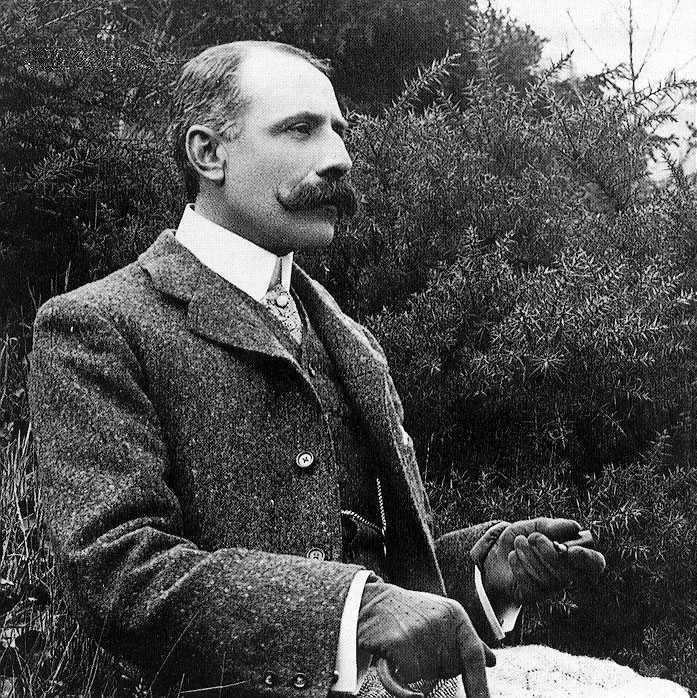

Edward Elgar
1857 — 1934
Sir Edward William Elgar, 1st Baronet was an English composer, many of whose works have entered the British and international classical concert repertoire. Among his best-known compositions are orchestral works including the Enigma Variations, the Pomp and Circumstance Marches, concertos for violin and cello, and two symphonies. He also composed choral works, including The Dream of Gerontius, chamber music and songs. He was appointed Master of the King’s Musick in 1924.
Adapted from the Wikipedia article on Edward Elgar.
From the period sources
Edward Elgar, born in Broadheath, near Worcester, England, in 1857, began his musical career as a violinist and organist. He served as conductor of the Worcester Instrumental Society from 1882 to 1889 and as organist at St. George’s from 1885 to 1889, according to A Biographical Dictionary of Musicians (1900). After living in London until 1891, he moved to Malvern, dedicating himself to composition. His early works included the oratorio The Light of Life (1896), a Choral Suite, and orchestral pieces such as the concert-overture “Froissart.” By 1905, A Biographical Dictionary of Musicians noted his oratorio The Dream of Gerontius (1900) and The Apostles (1903) were both produced at the Birmingham Musical Festival “with striking success.” His concert-overture “In the South” (1904) was identified as his latest important work, and he was knighted in the same year. The alto Muriel Foster notably sang the part of the Angel in The Dream of Gerontius (in German) at the Lower Rhine Musical Festival in Düsseldorf in 1902.