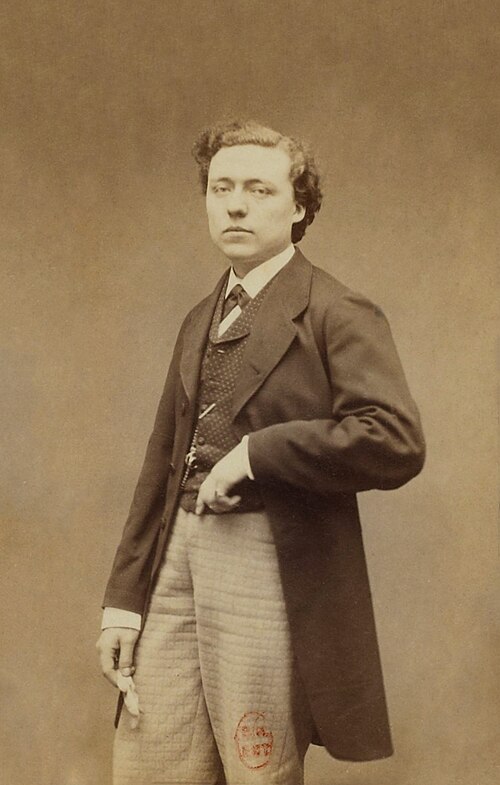

Louis Diémer
1843 — 1919
Louis Joseph Diémer was a French pianist and composer. He was the founder of the Société des Instruments Anciens in the 1890s, and also gave recitals on the harpsichord. His output as a composer was extensive, including a piano concerto and a quantity of salon pieces.
Adapted from the Wikipedia article on Louis Diémer.
From the period sources
Louis Diémer, a distinguished French pianist and composer, was born in Paris on February 14, 1843. He undertook a particularly brilliant course of study at the Paris Conservatoire, where he was a pupil of Marmontel for piano, Emile Durand for solfège, Bazin for harmony, Ambroise Thomas for fugue, and Benoist for organ (Biographie universelle des musiciens, 1880). Diémer earned numerous accolades, including the first piano prize unanimously in 1856 at the age of thirteen, a first harmony prize in 1859, and later a first prize for counterpoint and fugue, alongside a second organ prize (Biographie universelle des musiciens, 1880; A Biographical Dictionary of Musicians, 1905).
After completing his studies, Diémer achieved great success as a virtuoso, performing with distinction at the Alard, Pasdeloup, and Conservatoire concerts (A Biographical Dictionary of Musicians, 1905). His playing was noted for its “excellent mécanisme et par un style d’une rare pureté” (Biographie universelle des musiciens, 1880). He succeeded his former teacher Marmontel as piano professor at the Conservatoire in 1887 and was made a Chevalier of the Legion of Honor in 1889 (A Biographical Dictionary of Musicians, 1905). Diémer was also instrumental in the performance of new music, with composers such as Widor, Saint-Saëns, and Lalo dedicating pieces to him, which he premiered at the Colonne and Lamoureux Concerts (A Biographical Dictionary of Musicians, 1905). His compositions include a piano concerto, a septet for piano and wind instruments, and numerous characteristic piano pieces (A Biographical Dictionary of Musicians, 1905; Dictionary of Music, 1908). He also edited the two volumes of the “Clavecinistes Français” (Dictionary of Music, 1908; Grove’s Dictionary of Music and Musicians, 1904). Diémer’s influence extended to his teaching, with notable pupils such as Paul d’Indy (Dictionary of Music, 1896) and Joseph Risler, who won a first piano prize in Diémer’s class in 1889 (Grove’s Dictionary of Music and Musicians, 1922). In 1890, he founded the Société des Anciens Instruments, an ensemble group that gained renown in both Paris and London (The New Encyclopedia of Music and Musicians, 1924).