A guide to
Jeanne Demessieux
Montpellier 1921 — Paris 1968
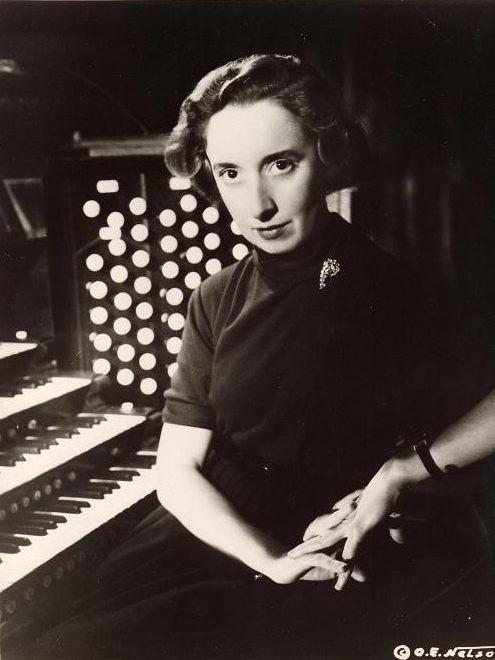
Jeanne Demessieux was the great organ virtuoso of the mid-twentieth century — a player of such command that contemporaries spoke of her in the same breath as the legendary pianists, and a composer who wrote some of the most difficult music in the entire organ repertory because she, almost uniquely, could play it. She gave more than seven hundred concerts across Europe and America, always from memory, from a working repertory said to exceed two thousand five hundred pieces, including the complete organ works of Bach and Franck. She was the first female organist to sign a recording contract, the organist of two great Paris churches, and, at the end, the survivor of one of the most painful ruptures in the history of the French organ school.
She was born in Montpellier on 14 February 1921, and her gifts declared themselves at once: first prizes in solfège and piano at the Montpellier Conservatoire by the age of eleven, and in 1933, aged twelve, admission to the Paris Conservatoire — where, in the very same year, she was already appointed organist of the church of Saint-Esprit. At the Conservatoire she took first prizes in harmony, counterpoint, fugue and piano, studying composition with Henri Büsser. But the decisive relationship was with the man who would make her and then unmake the partnership: Marcel Dupré.
Dupré, the debut, and the rupture
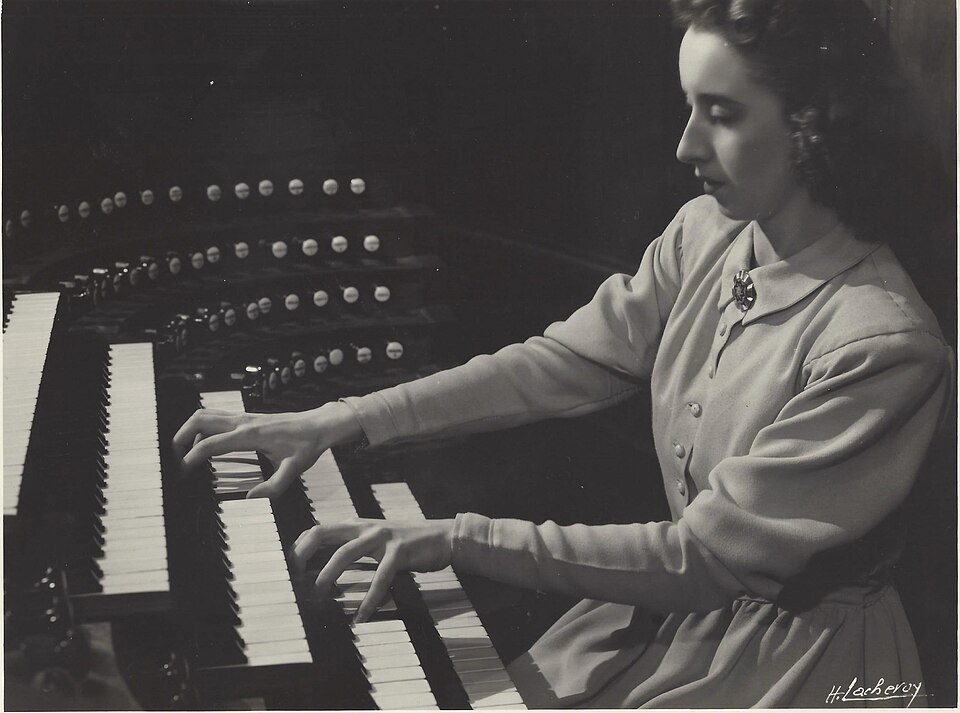
From 1936 Demessieux studied organ privately with Marcel Dupré, joining his Conservatoire class in 1939 and continuing under him for years more. Dupré groomed her for a single, calculated stroke: a début recital at the Salle Pleyel in 1946, prepared in secret over a long stretch of intensive work, designed to unveil her to Paris as a fully formed phenomenon. It worked. The concert — followed by a series of twelve recitals between 1946 and 1948 — made her overnight one of the most talked-about musicians in France.
And then, at the very moment of triumph, the relationship collapsed. Around 1946 Dupré “irrevocably turned his back” on his star pupil — the words are those of her biographer Christiane Trieu-Colleney — in a falling-out usually traced to “intrigues within the Paris organ world,” the exact causes of which remain obscure. The master who had built her career withdrew his support entirely. Demessieux went on without him, but the wound was deep and never fully healed.
The virtuoso, the composer, the recordings
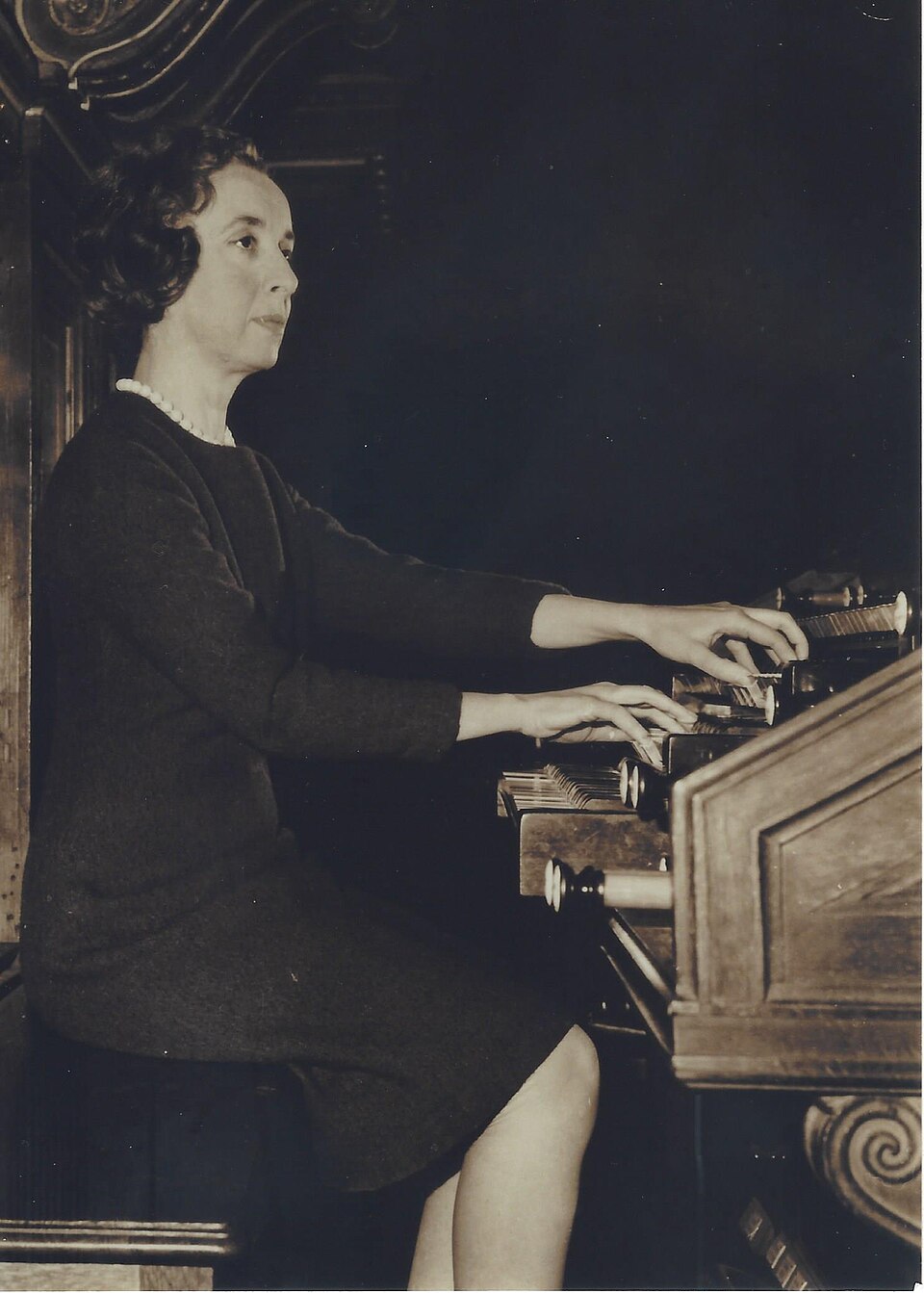
Her playing redefined what was thought possible on the organ — pedal technique of pianistic fluency, octaves and double-pedal passages that other organists simply could not match — and her compositions are the record of it. The Six Études, Op. 5 (1944) are studies of formidable difficulty; the Sept Méditations sur le Saint-Esprit, Op. 6 turn that virtuosity to visionary, chant-soaked contemplation; the 12 Chorale Preludes on Gregorian Chant Themes, Op. 8 and the late Te Deum, Op. 11 root her in the church she always served. She held Saint-Esprit from 1933, taught organ and improvisation at the conservatoires of Nancy and then Liège (from 1952), and in 1962 took the loft of La Madeleine in Paris.
She was also a pioneer of the gramophone. In 1947 she became the first female organist to sign a recording contract, and her 1959 world-premiere recording of Franck’s complete organ works won the Grand Prix du Disque. A telling detail of her temperament: after the violinist Ginette Neveu died in a plane crash in 1949, Demessieux never again travelled by air, crossing to her American tours and European engagements by sea and rail. Her pupils included Marie-Madeleine Duruflé — wife of the composer — and Pierre Labric.
A career cut short
Demessieux died of cancer in Paris on 11 November 1968, aged only forty-seven — her last year spent largely away from the concert platform, an ambitious project to record Messiaen’s complete organ works at Notre-Dame left unfulfilled. She was buried in the family tomb near Aigues-Mortes.
What survives is formidable. A body of organ music that still tests the finest players; a discography, gathered decades later into a complete Decca edition, that preserves a manner of playing of almost frightening authority; and the memory of a musician who, in barely twenty years of public life, raised the technical horizon of her instrument and proved — first woman to do many of the things she did — that the great organ lofts and the international concert circuit had no business being closed to her. She earned every one of them from memory.