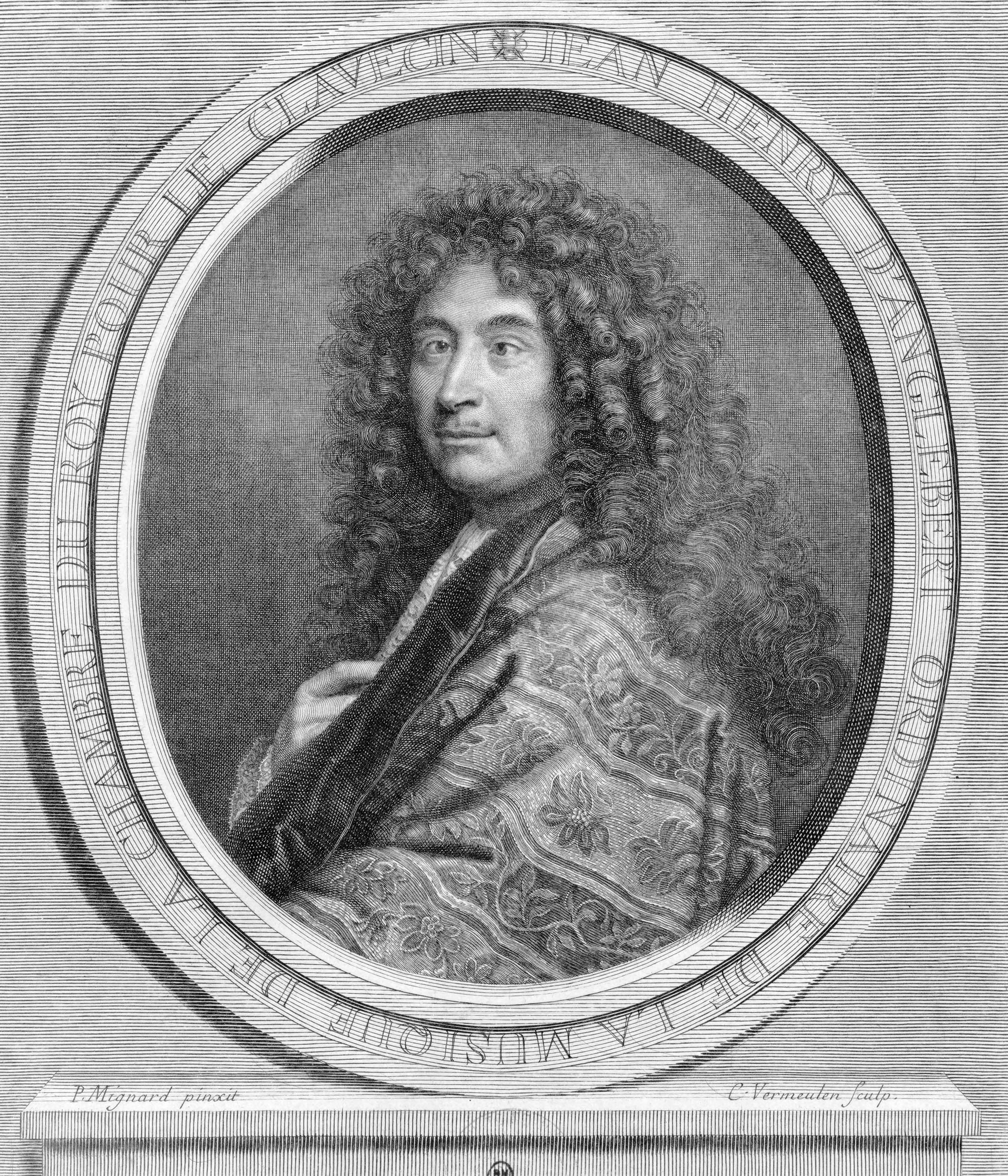

Jean-Henri D'Anglebert
1629 — 1691
Jean-Henri d’Anglebert was a French composer, harpsichordist and organist. He was one of the foremost keyboard composers of his day.
Adapted from the Wikipedia article on Jean-Henri d’Anglebert.
From the period sources
Jean-Henri D’Anglebert was a notable figure in the earlier French clavier school, serving as a clavier-player at the court of Louis XIV, a period whose “luxurious splendor and punctilious etiquette is distinctly called to mind by the compositions of this old school still in existence,” according to A History of Pianoforte-Playing and Pianoforte-Literature (1897). He was a pupil of Jacques Champion de Chambonnieres, the principal chamber cembalist to Louis XIV, who was highly esteemed for drawing an “unusually full tone” from the clavecin (harpsichord) through his unique touch, as reported by a contemporary, Le Gallois (A History of Pianoforte-Playing and Pianoforte-Literature, 1897; Dictionary of Music, 1908). D’Anglebert published a significant work in 1689 titled “Pieces de clavecin avec la manière de les jouer, diverses chaconnes, ouvertures, et autres airs de M. de Lully, mis sur cet instrument, quelques fugues pour l’orgue, et les principes de l’accompagnement Livre premier.” This collection included 22 variations on the “Folies d’Espagne” theme and organ fugues described as “strict and carefully wrought out” (A History of Pianoforte-Playing and Pianoforte-Literature, 1897). He was also listed among the great ancient masters whose compositions were published in the valuable collection La Maîtrise, founded in 1857 (Biographie universelle des musiciens, 1880).