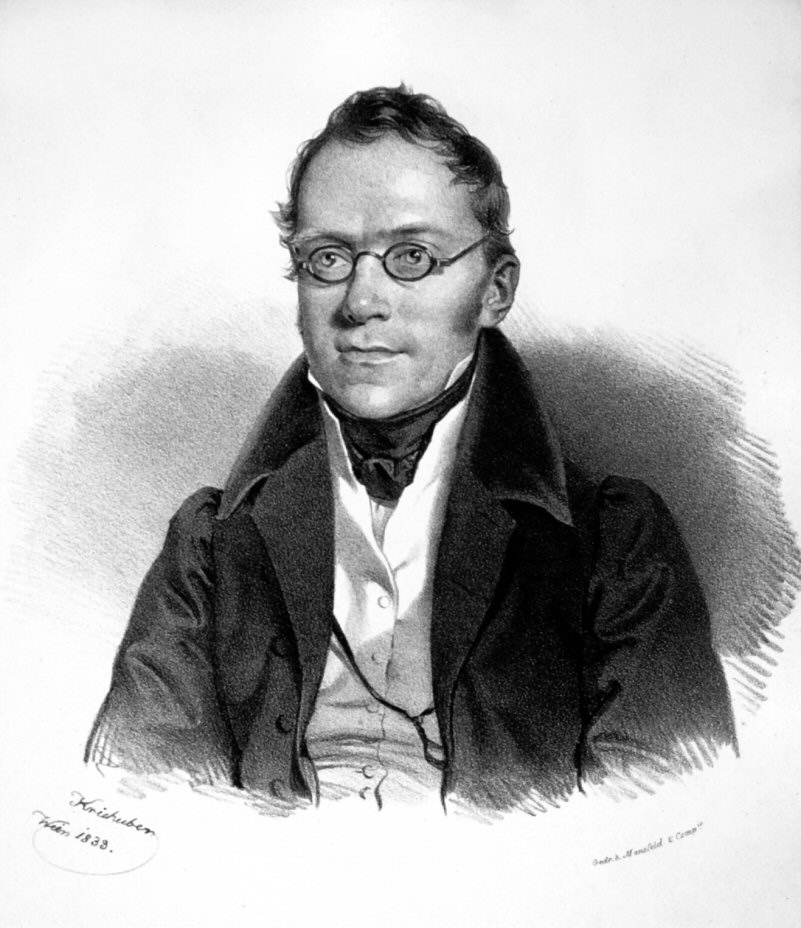

Carl Czerny
1791 — 1857
Carl Czerny was an Austrian composer, teacher and pianist of Czech origin. His music spanned the late Classical and early Romantic eras. His vast musical production amounted to over a thousand works and his books of studies for the piano are still widely used in piano teaching. He was one of Ludwig van Beethoven’s best-known pupils and would later on be one of the main teachers of Franz Liszt.
Adapted from the Wikipedia article on Carl Czerny.
From the period sources
Carl Czerny, born in Vienna in 1791, was a pianist and composer whose father, Wencezcelas Czerny, a piano professor from Bohemia, was his sole teacher, instructing him on the works of Bach, Mozart, Clementi, and Beethoven, with the latter’s compositions being a particular predilection for the young artist (Biographie universelle des musiciens, Vol. 3, 1837). Czerny began teaching piano at fourteen in 1805, and his popularity as a professor in Vienna was such that he spent over twelve hours daily giving lessons. This intense occupation may have hindered the development of his performing talent, despite his youthful execution being described as “chaleureuse et brillante” (Biographie universelle des musiciens, Vol. 3, 1837). His notable pupils included Emilie Belleville-Oury, a brilliant pianist (A Biographical Dictionary of Musicians, 1900), and Franz Liszt, who also received lessons from Hummel (Biographie universelle des musiciens, Vol. 3, 1837). Czerny’s prolific output, including an immense number of piano works and arrangements, was achieved by living a retired life, though he was described as an “homme aimable et de bonne compagnie” (Biographie universelle des musiciens, Vol. 3, 1837). While his works “n’ont pas sans doute les qualités qui font vivre dans l’histoire les productions de l’art et qui les rendent classiques,” they are “agréables, brillans, et font valoir le talent des exécutans sans leur offrir de grandes difficultés à vaincre” (Biographie universelle des musiciens, Vol. 3, 1837). Indeed, his compositions, alongside those of Haydn, Mozart, Clementi, and Cramer, were considered to “not present great difficulty to the pianist of moderate culture” (Biographical Dictionary of Musicians, 1886). Czerny also contributed to musical pedagogy through his German translation of Reicha’s voluminous work on harmony and his own “School of Practical Composition” and “Art of Playing the Ancient and Modern Pianoforte Works,” which were translated into English by John Bishop and became “useful class-books” (Biographical Dictionary of Musicians, 1886).