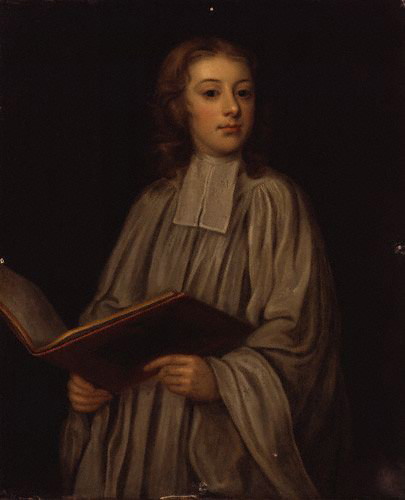

William Croft
1678 — 1727
William Croft was an English composer and organist.
Adapted from the Wikipedia article on William Croft.
From the period sources
William Croft, born in Nether-Eatington, Warwickshire, in 1677, received his musical education as a child of the Chapel Royal under the tutelage of Dr. Blow (Biographie universelle des musiciens, Vol. 3, 1837; Cyclopedia of Music and Musicians, Vol. 3, 1890). After his studies, Croft became organist at St. Anne’s parish church in Westminster, and by 1700, he was a singer in the Chapel Royal. Four years later, he was appointed joint organist of the Chapel Royal with Jeremiah Clark, whom he succeeded as sole organist upon Clark’s death in 1708 (Biographie universelle des musiciens, Vol. 2, 1883; Dictionary of Music, 1896). The following year, Croft also succeeded Blow as master of the choir children, composer to the Chapel Royal, and organist of Westminster Abbey (Biographie universelle des musiciens, Vol. 2, 1883).
Croft earned his doctorate in music from Oxford University in 1715 (Biographie universelle des musiciens, Vol. 2, 1883). While his principal compositions were for the church, he also published instrumental works, including six suites of airs for two violins and bass, six sonatas for two flutes, and six solos for flute and bass (Biographie universelle des musiciens, Vol. 2, 1883). His most renowned work, Musica Sacra, or select Anthems in score for 2-8 voices, to which is added the burial service, published in 1724, marked England’s first attempt at engraved music in score (Biographie universelle des musiciens, Vol. 2, 1883). Many of these anthems were composed as thanksgivings for victories during Queen Anne’s reign (Biographie universelle des musiciens, Vol. 2, 1883). His burial service, alongside Purcell’s, was considered by A General History of the Science and Practice of Music (1875) to be “hardly ever excelled.” Croft’s music continued to be appreciated into the 19th century, with Dr. Camidge performing his anthems at the York Concert festival in 1823, where they were “fort goûtés et applaudis” (Biographie universelle des musiciens, Vol. 2, 1883).