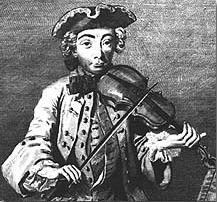

Michel Corrette
1707 — 1795
Michel Corrette was a French composer, organist and author of musical method books.
Adapted from the Wikipedia article on Michel Corrette.
From the period sources
Michel Corrette, a Chevalier of the Order of Christ, was organist of the grand Jesuit College in Paris’s rue Saint-Antoine in 1758, and later held the title of organist to the Duc d’Angoulême in 1780, according to Fétis’s Biographie universelle des musiciens (1837). An enthusiastic admirer of French music, Corrette hosted private concerts at his home, where he presented works by Lulli and Campra, alongside his own cantatas, which he accompanied on the harpsichord. It is even recorded that he had his servant sing during these musical sessions. He also established a music school and authored numerous elementary works, though Parisian musicians, in derision, reportedly called his students “les anachorètes” (Corrette’s asses), as noted in Fétis (1837).
Corrette was a prolific writer of instructional methods for various instruments. His “Méthode pour apprendre aisément à jouer de la Flûte traversière” was published after 1710, improving upon earlier treatises, as A General History of the Science and Practice of Music (1875) observes. Other pedagogical works include methods for harp (1774), alto (1782), violin (1783), cello (1783), and hurdy-gurdy (1783), the latter instrument being “extraordinarily popular” in 18th-century France, as A Dictionary of Music and Musicians (1879) notes. His son, also named Michel Corrette, followed in his footsteps as organist of the Church of the Temple and published “Pièces pour l’orgue dans un genre nouveau” in 1786, which included instructions for imitating thunder, according to Fétis (1837).