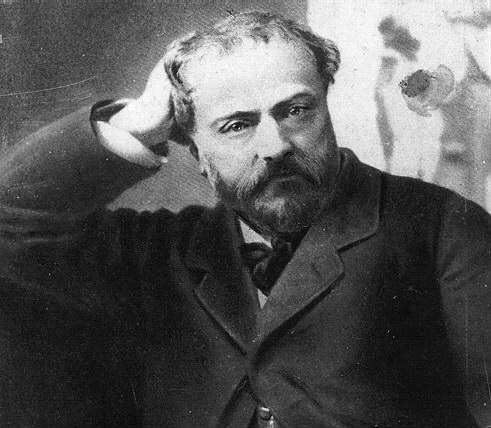

Emmanuel Chabrier
1841 — 1894
Alexis-Emmanuel Chabrier was a French Romantic composer and pianist. His bourgeois family did not approve of a musical career for him, and he studied law in Paris and then worked as a civil servant until the age of thirty-nine while immersing himself in the modernist artistic life of the French capital and composing in his spare time. From 1880 until his final illness he was a full-time composer.
Adapted from the Wikipedia article on Emmanuel Chabrier.
From the period sources
Emmanuel Chabrier, born in Auvergne in 1841, initially pursued law in Paris before dedicating himself to music, studying harmony under Semet and Hignard, and piano with Edouard Wolff. Despite this instruction, Grove’s Dictionary of Music and Musicians (1904) notes he was “in reality… self-taught.” His early works included the operettas L’Étoile (1877) and L’Éducation manquée (1879), which Grove’s deemed “more worthy of notice than most compositions of their kind.” He served as chorusmaster under Lamoureux in 1881, and from 1884-85, he was choir director at the Château d’Eau, where he assisted Lamoureux with rehearsals for the first two acts of Wagner’s Tristan und Isolde, as recorded in Grove’s Dictionary (1906).
Chabrier’s orchestral rhapsody España, based on original Spanish airs, achieved great success at the Château d’Eau concerts in 1883, according to Grove’s (1904). His grand opera Gwendoline, with a libretto by Catulle Mendès, premiered in Brussels in 1886, featuring an “important part” played by the Irish air “The Legacy” (Grove’s Dictionary, 1906). His opera Le Roi malgré lui (1887) was produced at the Opéra-Comique in Paris, but its initial run was cut short by a fire after only three performances, though it was later reproduced (Grove’s, 1904). Grove’s further comments that its “extraordinary brilliance, verve, and wit, would have ensured its success, had the libretto been at all worthy of the music.” Chabrier’s unfinished opera Briséis was later performed by the Schola Cantorum of New York in 1911 (Grove’s American Supplement, 1920).