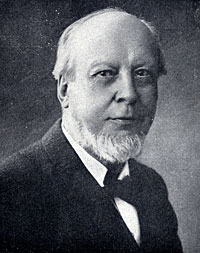

Dudley Buck
1839 — 1909
Dudley Buck was an American composer, organist, and writer on music. He published several books, most notably the Dictionary of Musical Terms and Influence of the Organ in History, which was published in New York City in 1882.
Adapted from the Wikipedia article on Dudley Buck.
From the period sources
Dudley Buck, a noted American organist, composer, and teacher, began his musical studies on piano with W. J. Babcock in his native Hartford, Connecticut. His father initially intended him for a commercial career, but Buck’s ardent desire to devote himself wholly to music led to a favorable assessment of his creative talent by kinsman James Cutler Dunn Parker (Famous Composers and Their Works, 1891). Buck then pursued a thorough schooling abroad, studying at the Leipzig Conservatory from 1858-59 under teachers such as Plaidy and Moscheles for piano, and Hauptmann and Richter for composition (Biographical Dictionary of Musicians, 1900). He continued his organ studies in Dresden with Johann Gottlob Schneider and harmony with Rietz, before spending a year in Paris (Biographical Dictionary of Musicians, 1886).
Upon returning to the United States in 1862, Buck first made his mark as an organist, gaining renown as a concert player across the country (Famous Composers and Their Works, 1891). He held significant posts, including organist of St. Paul’s Church and the Music Hall in Boston, and later served as assistant conductor under Theodore Thomas at the Central Park Garden concerts in New York (Biographical Dictionary of Musicians, 1886). In 1876, he settled in Brooklyn, becoming organist and choir-master of the Church of the Holy Trinity and director of the Apollo Club (Biographical Dictionary of Musicians, 1886; Cyclopedia of Music and Musicians, 1888). George P. Upton, writing in Famous Composers and Their Works (1891), praised Buck’s music for its “breadth and solidity,” noting his devotion to classic principles and the fugal style, tempered by “genuine poetic feeling and artistic fancy.” His sacred music, Upton claimed, “created an epoch” in American church music. Among his many compositions, his “Centennial Meditation of Columbia” was written for the 1876 Centennial Exposition in Philadelphia, and “The Golden Legend” won a prize at the Cincinnati festival of 1880 (Famous Composers and Their Works, 1891).