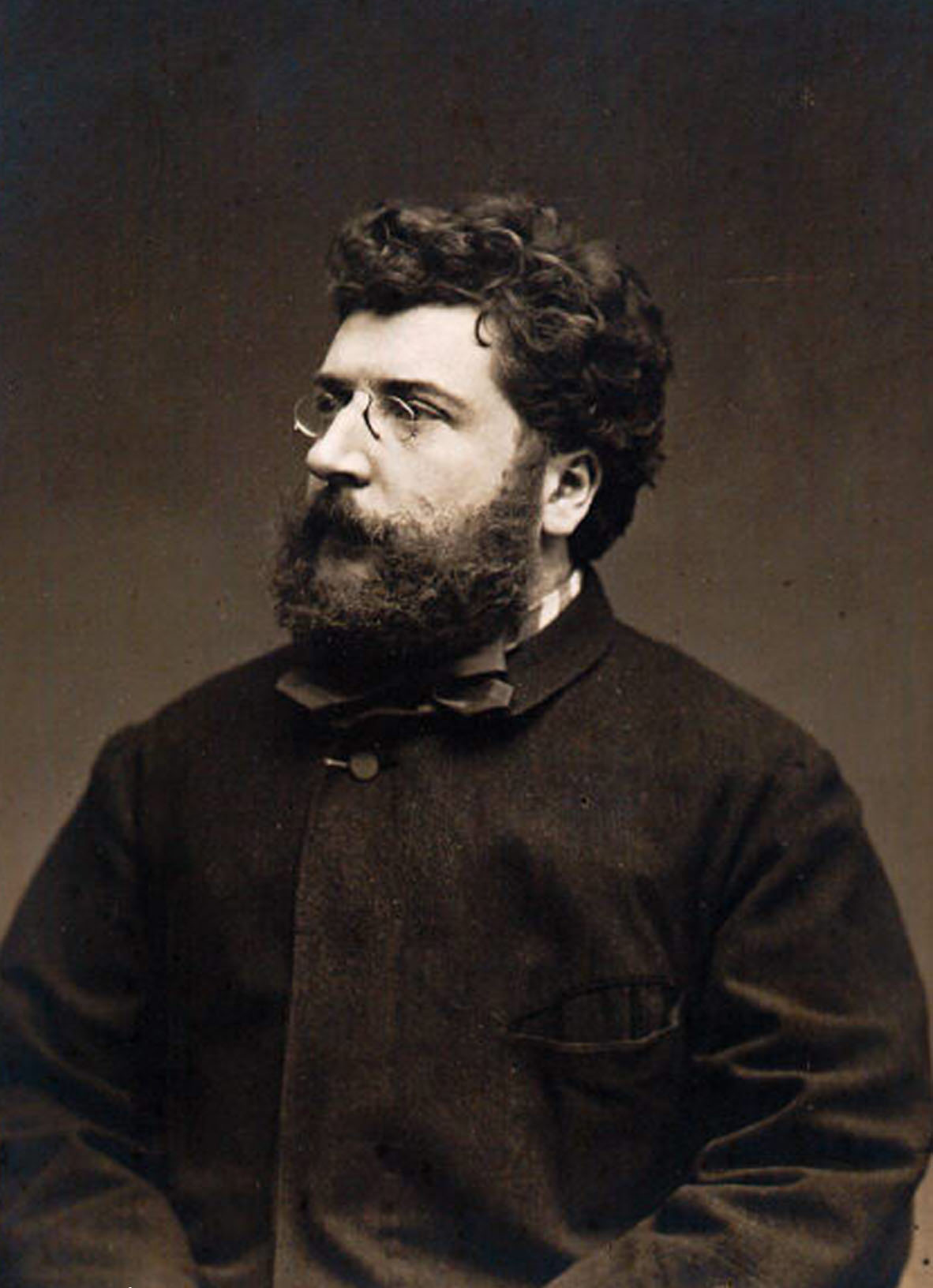

Georges Bizet
1838 — 1875
Georges Bizet was a French composer of the Romantic era. Best known for his operas in a career cut short by his early death, Bizet achieved few successes before his final work, Carmen, which has become one of the most popular and frequently performed works in the entire opera repertoire.
Adapted from the Wikipedia article on Georges Bizet.
From the period sources
Georges Bizet, whose baptismal names were Alexandre-César-Léopold, entered the Paris Conservatoire at the age of nine, studying piano with Marmontel, organ with Benoist, harmony with Zimmermann, and composition with Halévy, who would become his father-in-law (A Biographical Dictionary of Musicians, 1900). François Benoist, “chiefly famous as a teacher,” counted Bizet among his “more famous pupils” (Biographical Dictionary of Musicians, 1886). In 1857, Bizet won a prize from Offenbach for his operetta Le docteur Miracle, and also secured the prestigious Grand Prix de Rome (Dictionary of Music, 1896). While in Rome, he sent back works including an Italian opera buffa, Don Procopio, and a comic opera, La Guzla de l’Émir (A Biographical Dictionary of Musicians, 1905).
Upon his return to Paris, Bizet faced initial public indifference; his grand opera Les pecheurs de perles (1863) and La jolie fille de Perth (1867) “failed of popular approval,” and his one-act opera Djamileh (1872) “fared no better” (A Biographical Dictionary of Musicians, 1900). These works, according to the Dictionary of Music (1896), showed his “endeavours to emulate Wagner,” which “bore bad fruit for him” in France, where Wagner was then unpopular (A Biographical Dictionary of Musicians, 1900). However, the incidental music to Alphonse Daudet’s drama L’Arlésienne (1872) “turned the tide of popular favor,” and his masterpiece, Carmen, premiered on March 3, 1875, achieving “striking success” (A Biographical Dictionary of Musicians, 1900). Tragically, Bizet died just three months after this triumph, which “showed what B. might have done had he been spared” (A Biographical Dictionary of Musicians, 1905).